
The Last Thing They Hear Before They Fall Asleep Matters
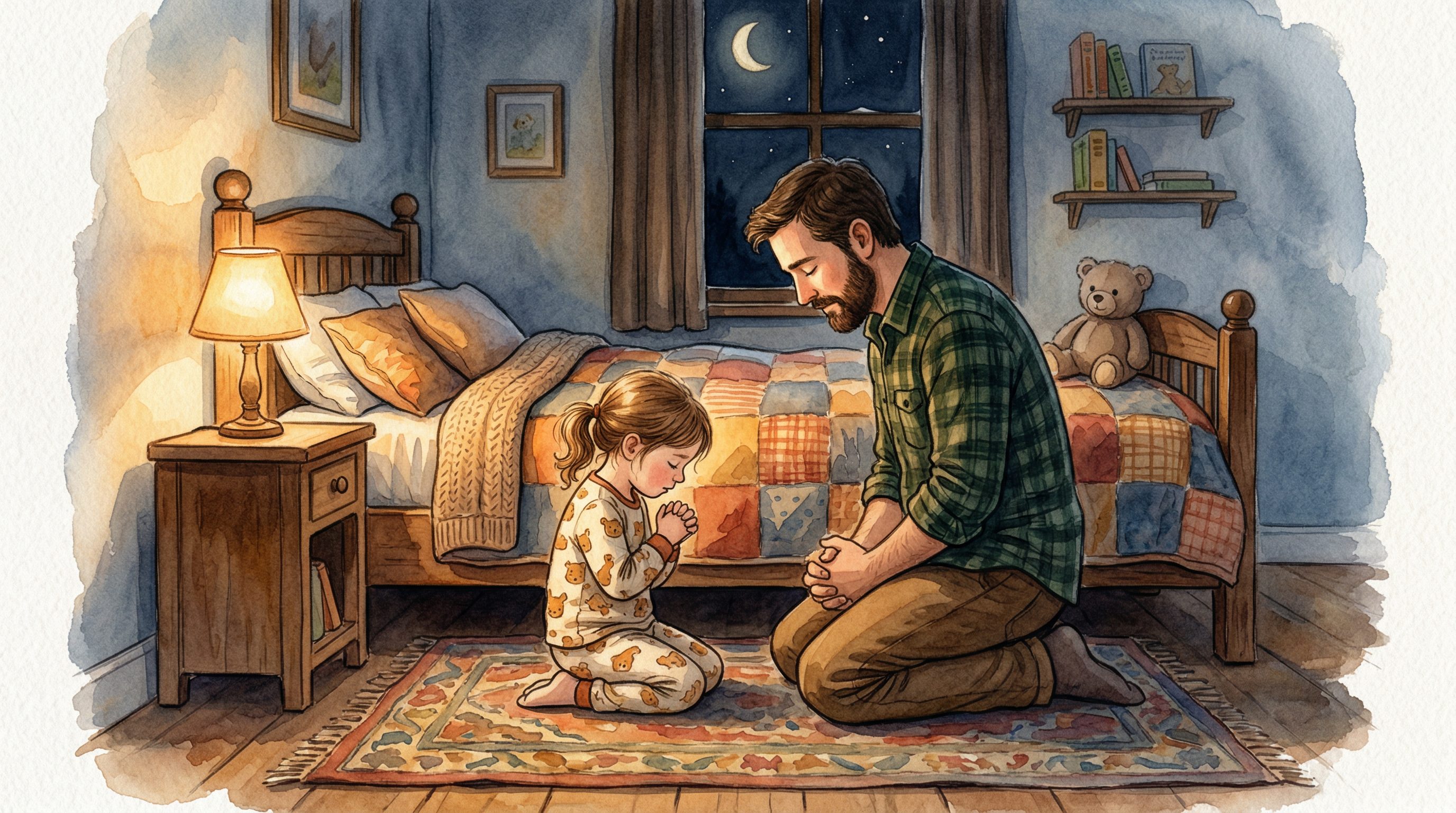
There's a window at bedtime — maybe ten minutes if you're lucky — where your kid's defenses are down. The day is done. The negotiating is over. They're tired and soft and actually listening. What you say in that window sticks in a way that the same words said at breakfast or in the car don't.
I wake up at 4:30 in the morning and I'm at work before most people are out the door. Bedtime isn't a backup plan for me — it's the plan. It's the only window I have to do this thing. And over time I've realized that's not a limitation. That window is actually better than any other time of day for this particular conversation.
Teaching your kids about God's love at bedtime is one of the highest-leverage things you can do as a dad. Here's how to do it well.
Why Bedtime Works for This Conversation
God's love is an emotional topic — not in a manipulative way, but in the sense that it requires the heart to be open to receive it. Kids process emotionally at bedtime in a way they don't during the rushed, task-oriented hours of the day. They ask harder questions. They're more likely to say what's actually bothering them.
Research on memory consolidation shows that information encountered close to sleep is disproportionately retained overnight. What you tell your kid about God's love tonight is more likely to resurface in their thoughts tomorrow than the same message delivered at lunch. You're not just filling a time slot. You're using the most effective window in the day.
That changes how seriously you take this. Not more pressure — just more confidence. Showing up matters. The moment is built for what you're trying to do.
<
What Kids Need to Know About God's Love
There are a few core truths that, if your kid actually carries them into adulthood, will change everything about how they live:
- God's love is not earned. It doesn't go up when they're good and down when they mess up. It just is. Romans 8:38-39 says nothing can separate them from it — nothing they do, nothing that happens to them.
- God's love is personal. He didn't love "humanity" in the abstract. He knows your kid's name, their laugh, what they're afraid of, what they're proud of. That specificity matters.
- God's love is active. It does things. John 3:16 — God gave. That's not passive feeling. That's love in motion, love that costs something.
- God's love is permanent. Circumstances change. Feelings change. People come and go. God's love doesn't change. For a kid growing up in an uncertain world, this is one of the most stabilizing things they can know.
You don't need to cover all four in one night. Pick one, say it clearly, and let it sit.
Simple Scripts for Different Ages
Here's what this actually sounds like with a real kid in a real room:
For ages 4-6: "I want to tell you something before you go to sleep. God loves you. Not because you were good today — though you were. But because He made you, and you're His. Nothing changes that. Not ever. Goodnight."
For ages 7-9: "Hey, before you sleep — can I ask you something? Is there anything from today that made you feel like you messed up or didn't do well enough? [Let them answer.] I want you to know that God already knows all of that. And He still loves you exactly the same. That's the deal He made, and He doesn't break it."
For ages 10+: "I've been thinking about something. There's this verse — Romans 8:38 — that says nothing can separate you from God's love. Not anything you do, not anything you're afraid of, not anything happening in the world. I believe that. And I want you to build your life on it."
<
Using a Devotional Series to Anchor This
The conversations you have at bedtime are more powerful when they have structure. A devotional series gives you a thread — something you're building together over multiple nights rather than starting from scratch every time.
The You Are Loved series was built specifically for this. Each night covers a different dimension of what God's love means — it's not repetitive, it builds. By the end, your kid has a richer picture of something they've heard their whole life but maybe never really understood.
For the broader context of who God is — which matters for understanding His love — this guide on introducing your child to God is the foundation layer. You can't fully receive love from someone you don't know. Building the relationship first makes the love conversation land differently.
What to Do When the Questions Come
Bedtime has a way of producing the big questions. "Does God love me even when I'm mean to my brother?" "If God loves me, why did that bad thing happen?" These are real questions, not ambushes. And they're worth taking seriously rather than deflecting.
You don't need perfect answers. "I don't fully know, but here's what I believe" is a completely legitimate response. What your kid needs is a dad who stays in the conversation — who doesn't flinch when the hard questions come, who takes them seriously, who models that faith and honest questions can coexist.
That posture is itself a form of teaching. You're showing them that God is big enough to handle their questions. That's one of the most important things they can learn.
<
When Your Kid Asks If God Really Loves Them
Some kids accept this easily. Others push back — not because they're troubled, but because they're honest. "But how do I know? I can't see Him." That's a real question and it deserves a real answer.
Here's one way to approach it: "You can't see the wind either, but you can see what it does — the leaves move, the door closes. God's love is like that. You can see what it does: there are people who love you, you woke up today, there are things in your life that are genuinely good. Those things didn't just happen. Someone who loves you put them there." This isn't a proof. But it's something your kid can hold onto — a way of noticing evidence that isn't invisible. And then you can add the most important part: "And when it's hard to feel it, you can tell me. We'll talk about it. That's what we do here."
Closing the Night Well
End with something true and specific. Not a closing prayer that feels obligatory — a real statement about what you believe and what you want them to know.
"You are loved. Completely. By me and by God. There's nothing you could do to change that. Sleep well."
That's it. You don't need more than that. But say it slowly, make eye contact, and mean it. Your kid's brain is about to consolidate everything from today. This is the last data point they get before that happens.
Make it count.
For the full picture of why this time matters and how to use it well, the devotional on love gives you the content side — what love actually means, how to define it in a way that sticks. And for ideas on making the broader routine work night after night, this article on why bedtime is the best time covers the why behind everything we've been talking about here.
📖 Read This Tonight
The You Are Loved series is the perfect complement to this conversation — each night adds another layer to your kid's understanding of what God's love really means.
Get Notified When New Series Drop
We add new devotional series regularly. Sign up to hear about them first.
Join the Community