Morning Devotions Weren't Possible — So I Stopped Pretending
I wake up at 4:30 in the morning. I'm at work by 6. For me, the idea of sitting down with my kids for a devotional before school isn't a scheduling challenge — it's just not a thing that exists. And for a while, that felt like a failure. Like I was already behind before I started.
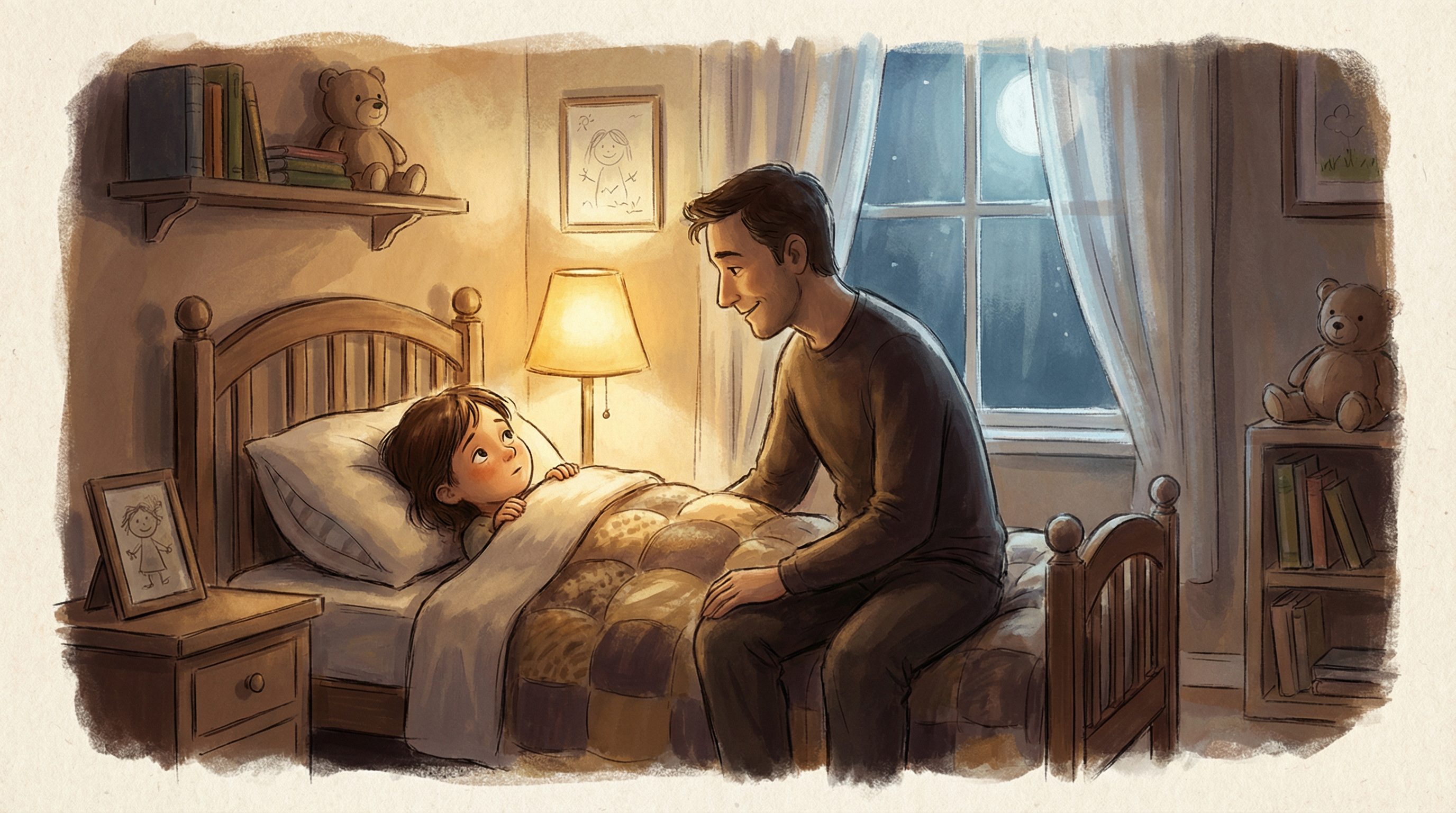
Then I stopped trying to force something that didn't fit my life and started paying attention to what was actually there. Bedtime was already happening. I was already in my sons' rooms at the end of the day. I already had their attention, their sleepy openness, their willingness to slow down. I wasn't missing the window — I'd just been looking for it at the wrong time of day.
This isn't theoretical. This is my schedule, every day. And if yours looks anything like mine, everything I'm about to say will feel less like advice and more like permission to stop feeling guilty about the mornings.
What's Actually Happening in Your Kid's Brain at Bedtime
Here's something I didn't know until I started digging into it: the transition to sleep is one of the most emotionally open windows in a child's day. As kids wind down, their nervous system shifts — cortisol drops, the brain moves out of problem-solving mode, and the emotional centers become more active. In plain terms: they're more receptive to connection and more likely to process what they hear.
This isn't just parenting folklore. Research on memory consolidation shows that information encountered just before sleep is disproportionately likely to be retained. The brain replays experiences during sleep — which means a verse, a story, a question you asked at 8:30 p.m. is more likely to resurface in your kid's mind the next morning than the same content delivered at breakfast.
You're not just finding a convenient time slot. You're using the most neurologically effective window in the day for this kind of learning.

Bedtime Is Already a Ritual — You're Adding to It, Not Building from Scratch
One of the hardest things about building any new habit is creating the infrastructure for it. You have to remember to do it. You have to find the time. You have to fight through the activation energy of starting something new every single day.
Bedtime solves all of that. You already have a bedtime routine. Brush teeth. Put on pajamas. Get water. Maybe a story. The ritual already exists — all you're doing is adding one element to something that's already happening. That's a completely different psychological ask than trying to create a new routine from nothing.
Habit researchers call this habit stacking — attaching a new behavior to an existing one so the existing behavior becomes the trigger. When brushing teeth triggers the thought now we do devotions, you've removed the need for willpower entirely. The routine carries you. This is exactly why the 5-minute bedtime devotional routine works so well for busy families — it slots in without disrupting anything.
No Competition. Just You and Your Kid.
Think about every other time of day you might try to have a meaningful conversation with your child. Dinner: siblings talking over each other, someone doesn't like what's on their plate, a phone buzzes. Afternoon: homework, activities, screens everywhere. Car rides: decent, actually, but short and you can't make eye contact.
Bedtime is the only time in the day when there's genuinely nothing competing for their attention. No screens. No siblings running around. No next thing on the schedule. They're in bed. They're calm. They have nowhere to go. And — this is the key thing — most kids actually don't want the night to end. They want connection. They want you to stay a little longer. That natural pull toward more time with you? That's the current you're swimming with when you do devotions at bedtime. Every other time of day, you're swimming against it.
Bedtime Is When Kids Say the Real Stuff
Every parent knows this, even if they haven't put words to it. Something about the dark, and the quiet, and the weight of the day being done — kids drop their guard at bedtime in a way they don't anywhere else.
I've had my sons tell me things at 8:45 p.m. that they would never have brought up at dinner. Worries about friendships. Questions about God that had been sitting in their heads for weeks. Fear about something coming up at school. This isn't a coincidence. The same neurological shift that makes them more receptive to learning also makes them more emotionally open.
When you're consistently doing a bedtime devotional — consistently creating a space where it's quiet, it's safe, and you're asking thoughtful questions — you're training your kids to use that window for real conversation. You're building a communication habit that will pay dividends for years. The devotional is the door. Connection is what walks through it.
If you want the full step-by-step breakdown of how to structure these conversations, check out my guide on how to do bedtime devotions with your kids.
The Dad's Companion: After They're Asleep, It Becomes Your Time
I'll be honest about something: my own faith consistency hasn't always been where I wanted it to be. There have been seasons where I'm doing devotions with my boys every night and quietly asking myself — why should I tell my son this is important if I'm not doing my own? That question bothered me enough that I built a solution into the app itself.
With the Dad's Companion version built into every series, after my boys fall asleep, I get my own version of the same devotional — same passage, different depth. I read it in the morning, during my quiet time before anyone else is up. It connects what I read with my sons the night before to something I'm actually carrying as a dad. It's not a separate discipline I have to manufacture — it's already there, waiting for me at 5 a.m.
A lot of dads tell me their own spiritual life has quietly grown through the Dad's Companion, not because they were trying to do more, but because it was already right there. That's exactly the kind of low-friction, high-impact habit that actually sticks.
The Let Me Tell You About God series is a good example — the kids' version is a gentle, wonder-filled introduction to who God is, and the Dad's Companion takes the same questions and turns them back on you in a way that's surprisingly honest and useful.
Practical Tips for Making It Actually Work
Same time every night. It doesn't have to be exactly 8:00 p.m. But it should be the same point in the routine — after teeth, before lights out. Consistency is the whole game.
Keep it short. Five to eight minutes. If you plan for fifteen, you'll skip it on tired nights. If you plan for five, you'll do it every night and sometimes it'll naturally run longer. Always better to go shorter and let it grow than to go long and dread it.
Let them hold the phone. Give your kid the device. Let them be the one to tap to the next page. It sounds minor but it shifts them from passive to active, and it changes the whole dynamic. They're participating, not being read at.
Don't perform. You don't need to do voices. You don't need to be entertaining. Just read it like you're talking to them. Kids respond to your real voice — the one you use when you're telling them something that actually matters — far more than any performance.
You can browse the full Hosted Devotions library to find a series that fits where your family is right now. There are series for big questions about faith, for kids navigating worry, for brothers learning to have each other's backs — pick the one that matches what's going on in your house and start with Day 1 tonight.
What If You Miss a Night?
Pick up tomorrow. That's it. That's the whole answer.
Seriously — one of the most common things that kills a good habit is the streak-is-broken spiral. Don't go there. Missing a night doesn't mean the habit is broken. It means you missed a night. Two nights in a row is a coincidence. Three nights in a row is a pattern worth course-correcting. One night is just Tuesday.
The dads who do this consistently over months aren't the ones who never miss a night. They're the ones who don't make a big deal when they do. Tomorrow is always there. Open the app, start where you left off, and keep going.
📖 Read This Tonight
Start with Let Me Tell You About God — a gentle, wonder-filled series for kids asking big questions about faith. Five minutes tonight. That's all it takes to start.
Get Notified When New Series Drop
We add new devotional series regularly. Sign up to hear about them first.
Join the Community