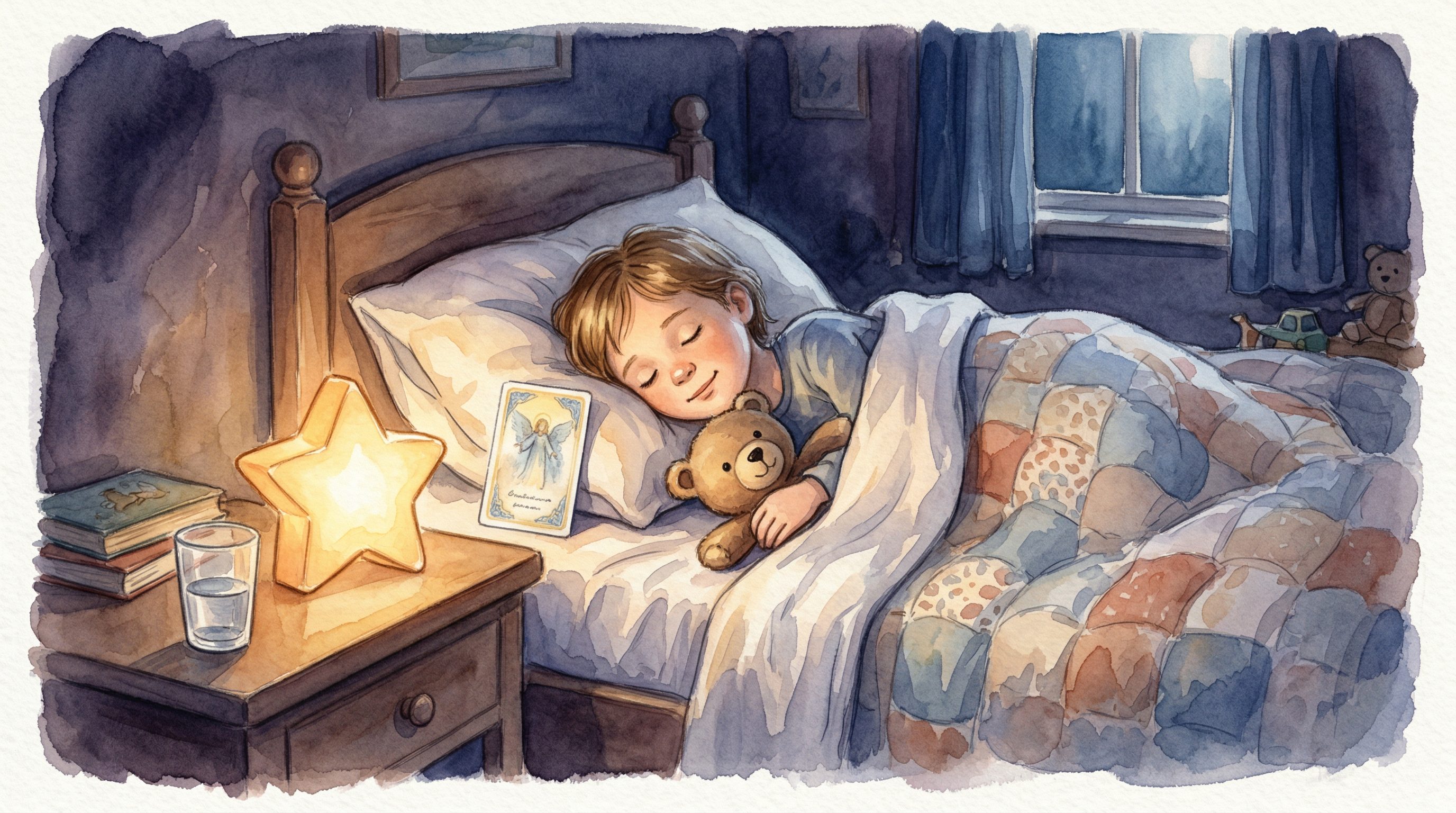
Bedtime Is When Fear Comes Alive
You've noticed it. The lights go out, you say goodnight, you take two steps toward the door — and then it starts. "Dad, wait." "Can you stay a little longer?" "I keep thinking about something." "I heard a noise."
This is not manipulation. This is not stalling (well, sometimes it's stalling — but usually there's something real underneath it). Nighttime is when children's brains shift into fear mode. The distractions of the day are gone. The house gets quiet. The shadows that didn't exist at 3pm are suddenly everywhere. And your child is alone with their thoughts in a way they haven't been all day.
Most kids go through seasons of nighttime fear. Monsters under the bed. Shadows that look like something. The feeling of being alone in the dark. Some kids carry it every night for months. Some kids have it come and go. All of it is real, all of it is exhausting for everyone, and all of it is actually a doorway into something meaningful if you know how to use it.
Why the Dark Feels Different
There's a physiological reason nighttime fear spikes at bedtime, and it's worth understanding — both for your own patience and so you can explain it to your child in a way that doesn't make them feel broken.
During the day, the brain is busy. Input is constant — school, play, screens, friends. Fear exists, but it doesn't have room to expand. At night, that input stops. The imagination fills the silence. And the part of the brain responsible for detecting threats (the amygdala) doesn't actually sleep until your child does — so it's scanning, interpreting shadows as shapes, sounds as dangers, darkness as something that might contain something.
This is not weakness. This is how human brains are built. The fear your child feels in the dark is, in some evolutionary sense, rational. We did live in a world where darkness meant danger.
But we also live in a world where God is real, and he doesn't sleep either.
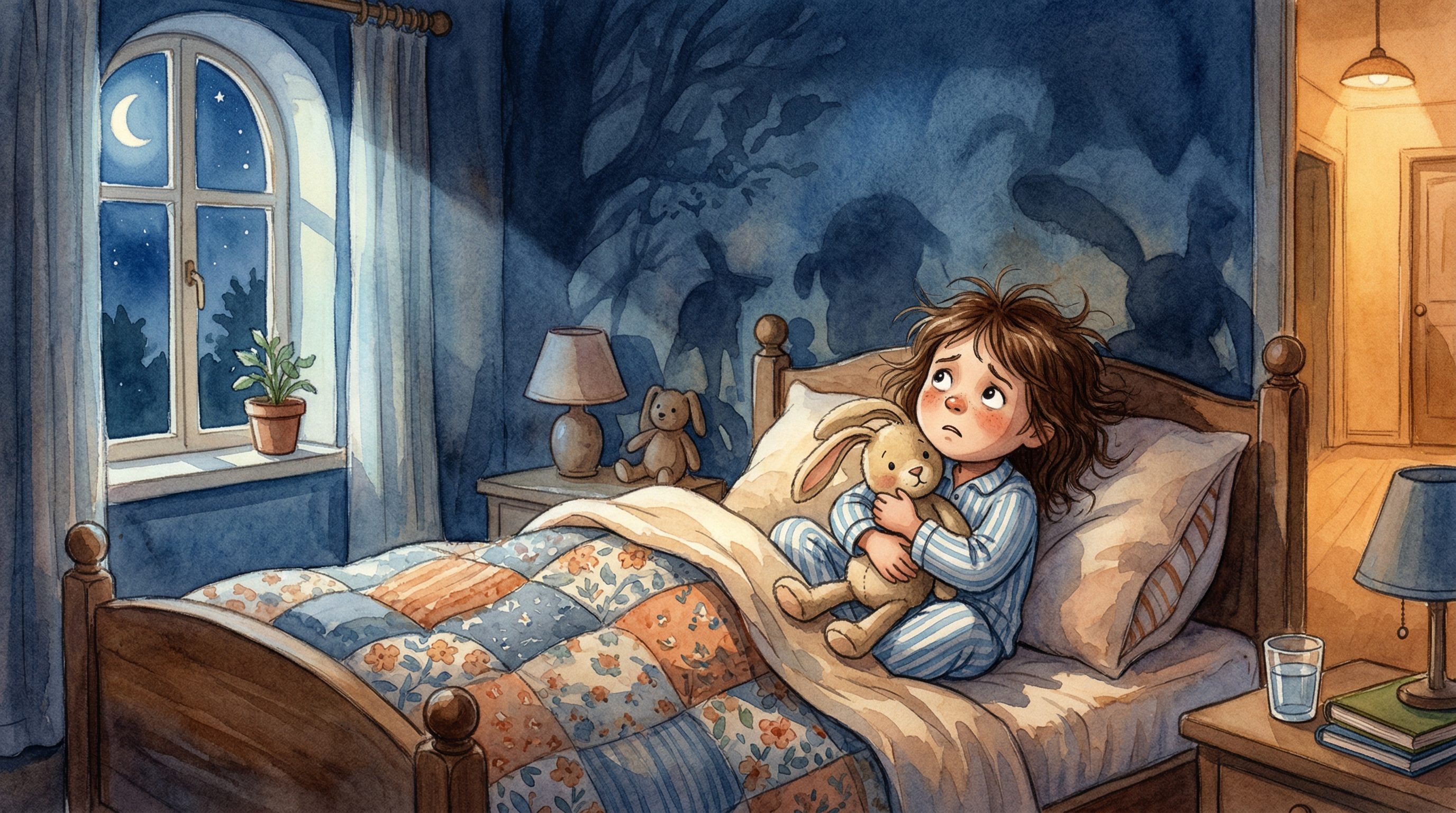
Specific Fears, Specific Answers
Not all nighttime fear is the same, and the approach matters. Here's how to break it down:
Monsters and creatures: Don't just say "monsters aren't real." Try: "You're right that the dark can feel scary. But nothing that could hurt you is in this room. And if there were? God is bigger." Then pray with them — out loud, specifically: "God, protect this room. Help [child's name] know you're here." Kids need to hear prayer happen in their space.
Shadows and shapes: This one responds well to calm investigation. Turn on the light together and look at what made the shadow. A chair, a coat, a stack of books. "Here's the thing about shadows — they look like something, but they're just light blocked by something normal." Then turn the light off together. Let your child be brave enough to look again in the dark with you beside them.
Being alone: This is the deepest one. Your child isn't scared of nothing — they're scared of being without you. The honest answer here is: "I'm right down the hall. And God is right here. You are never actually alone." That truth has to be repeated. A lot. It doesn't stick the first night.
Worries that become nighttime fears: Sometimes kids aren't scared of the dark — they're scared of something that happened or might happen, and the dark is just where it surfaces. Ask: "Is there something you're worried about?" More often than not, something will come out. Those conversations need time. Don't rush them.
A Nightlight Prayer Routine
Here's something concrete — a simple routine that gives your child something to do with their fear instead of just lying there experiencing it. We use a version of this, and it works better than anything else I've tried.
Step 1: The scan. Before you leave the room, do a quick scan together. Not to prove there's nothing scary (don't play into that dynamic) — but to establish: "This is our room. It's safe. We're checking it together." It's a brief, calm walk-through. Thirty seconds.
Step 2: The verse. Pick one verse and make it theirs. Post it on the wall, or write it on an index card by the bed. For nighttime fear, Psalm 4:8 is powerful: "In peace I will lie down and sleep, for you alone, Lord, make me dwell in safety." For younger kids, Psalm 56:3 in a simple version: "When I am afraid, I trust in God." One verse, every night, until it's automatic.
Step 3: The prayer. Short. Specific. Your child can say it or you can say it — or both. "God, thank you for this room. Thank you for being here in the dark. Help [child] sleep knowing you're watching over him. Amen." Then you leave. Don't come back for the fears (unless something real is happening). The routine holds.
Step 4: A signal. Give your child a small physical anchor — something they can hold or touch when fear spikes. A small cross, a smooth stone with a verse on it, a bracelet. Something that says: God is with me. Physical objects anchor abstract truths for kids, especially in the dark.
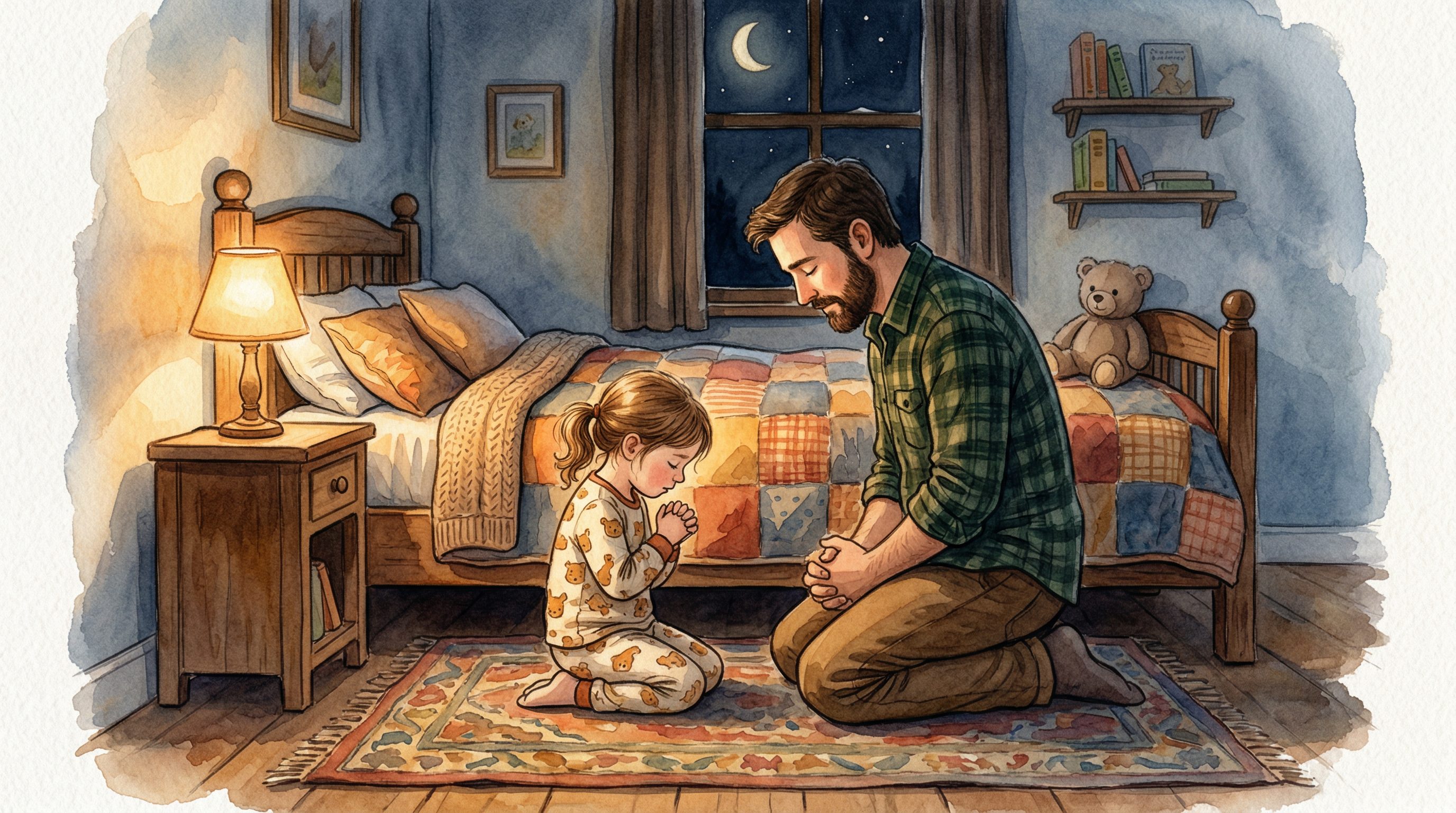
Verses That Work in the Dark
Not all scripture is created equal for a scared seven-year-old. These are the ones that actually land:
Psalm 121:3-4 — "He will not let your foot slip — he who watches over you will not slumber; indeed, he who watches over Israel will neither slumber nor sleep." God is awake when your child is scared. He doesn't sleep. That's not metaphor — that's the actual truth, and kids can grab onto it.
Isaiah 41:10 — "Do not fear, for I am with you; do not be dismayed, for I am your God." The reason not to fear isn't that nothing scary exists. It's that God is present.
Deuteronomy 31:6 — "Be strong and courageous. Do not be afraid or terrified because of them, for the Lord your God goes with you; he will never leave you nor forsake you." Moses said this to Joshua before he walked into the most terrifying challenge of his life. Your child can have the same word.
The Worry Warriors series on Hosted Devotions was written with nights like this in mind — short enough to read when your child is already half-asleep, direct enough to actually say something. If nighttime fear is a regular thing in your house, it's worth making it your current series. The broader guide on kids and fear goes deeper on the theology if you want to understand what's underneath the nighttime stuff.
What Not to Do
A few traps that make nighttime fear worse over time:
Staying until they fall asleep every night. It feels kind. It is kind, short-term. Long-term, it builds dependency and signals to your child that they actually can't handle being alone — which confirms the fear. Gradual withdrawal is better than cold-turkey, but the goal is your child learning to settle themselves with God as their anchor, not you.
Dismissing the fear. "There's nothing to be scared of" shuts the conversation down and teaches your child that their fear doesn't make sense to you. It does make sense. It just needs redirecting.
Making it a big deal. If you treat the fear as an enormous problem every night, you amplify it. Matter-of-fact is better: "Sounds like the fear is being loud tonight. Let's pray." Then you pray and leave. The routine stays the routine.
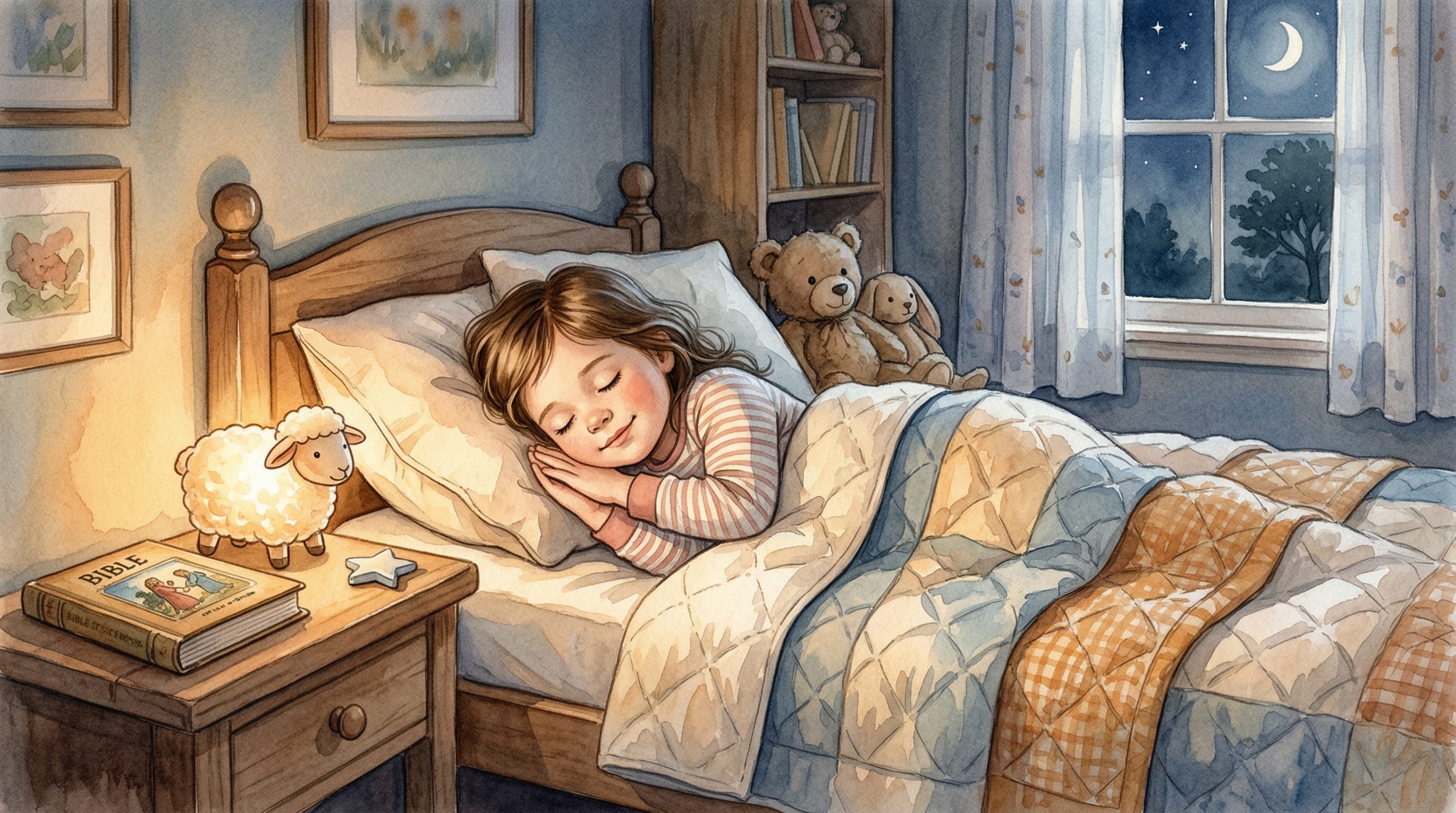
The Long Game
Nighttime fear doesn't resolve in a week. For some kids, it's a season that comes and goes — more intense during stressful periods (school transitions, big family changes, anything disruptive), less intense when life is stable.
The goal isn't to make your child fearless at night. The goal is to wire them, over months and years, to reach for God when fear spikes — to have a reflex that says God is here before the fear takes hold.
That's a deeply valuable thing to build. It doesn't just help at bedtime. It helps at 25, at 40, when the stakes are real and the dark is metaphorical.
And it starts in a room with a nightlight, and a verse on the wall, and a dad who stayed long enough to pray before walking out the door.
If you're working on the bedtime routine more broadly, why bedtime is the best time for family devotions is worth reading — and bedtime devotionals specifically for anxious kids goes deeper on the anxiety angle.
📖 Read This Tonight
The Worry Warriors series is short, direct, and built for bedtime. If nighttime fear is a regular thing in your house, make this your next series — it gives kids specific tools for when fear peaks.
Get Notified When New Series Drop
We add new devotional series regularly. Sign up to hear about them first.
Join the Community