
This Is the Hardest Version of Bedtime
I haven't been through serious illness as a parent. My boys are healthy, my wife is healthy, and I'll be honest — I don't know what it's like to tuck your kids in when you're the one who's sick, or when your kids are watching the other parent go through something scary. But dads going through it tell me the same thing, over and over: the hardest part isn't the illness. It's not knowing what to say to your kids.
There's a version of this where you try to protect them by keeping things vague. "Dad's just tired. Mom's resting. Everything's fine." And then there's the version that actually helps — where you bring them into the truth at the right level, give them something to hold onto, and do it together. That second version is where devotionals come in.
This isn't about manufacturing peace you don't have. It's about giving your kid a language for fear, a framework that says: God is here, even when things feel really wrong. And doing that together — even badly, even on a hard night — is better than silence.
What Kids Actually Feel When a Parent Is Sick
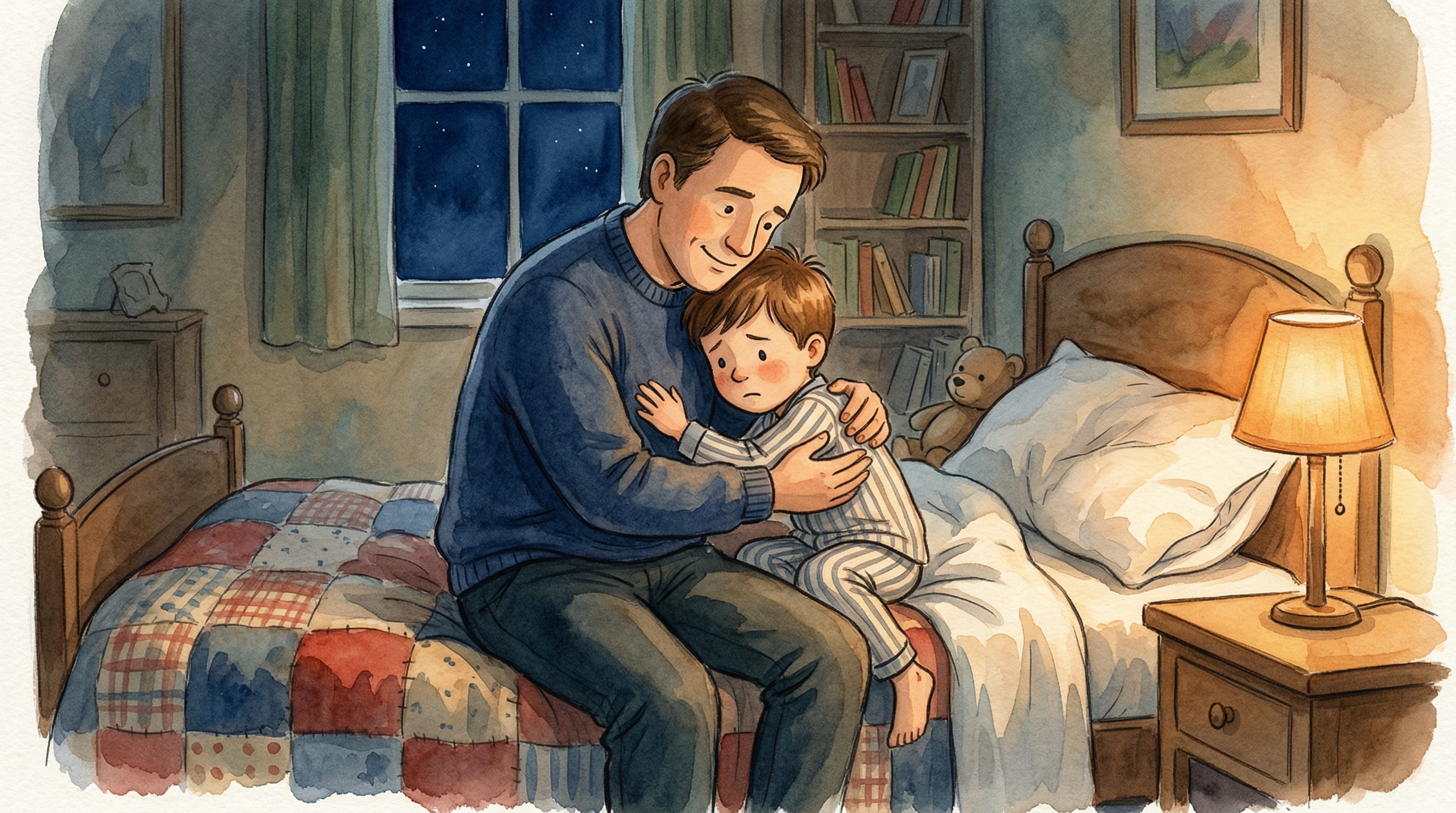
Kids don't process illness the way adults do. They don't research prognosis or quietly worry about finances. They feel it in their body. The house feels different. Routines shift. The parent who used to do bedtime can't. And the worst part for most kids? They don't have words for what they're feeling, so they act it out instead.
Dads who've been through serious illness — their own or their spouse's — describe their kids acting out more, clinging more, or going completely quiet. A 6-year-old doesn't say "I'm scared I'm going to lose you." He throws a tantrum at dinner or starts wetting the bed again. A 9-year-old doesn't say "I feel helpless." She gets angry at everything and nothing.
Understanding what's underneath the behavior is step one. The behavior isn't the problem. The unspoken fear is the problem. And that's exactly what a devotional can address — not by explaining it away, but by naming it out loud and bringing it to God together.
What Kids Most Need to Hear
A few things come up consistently when you ask dads what actually helped their kids during a parent's illness:
- "We're going to tell you the truth" — Kids handle hard truths better than they handle uncertainty. Vague reassurance breeds anxiety. Honest, age-appropriate truth breeds trust.
- "Your feelings make sense" — Scared, sad, angry — all of it is okay. They need permission to feel it.
- "God doesn't leave" — This is the one that sticks. Not "everything will be fine." Not "God will fix it." Just: He doesn't leave.
- "You're not responsible for this" — Young kids often secretly think they caused it somehow. This needs to be said out loud.
A short devotional — even 5 minutes — gives you a structured space to say all of these things without it feeling like a big heavy conversation that no one knows how to start.

How to Actually Run a Devotional When You're the Sick Parent
This is where I want to be practical, because the advice that exists on this topic is mostly theoretical. If you're the sick parent — if you're the one in the hospital bed, or exhausted from treatment, or just drained in a way that makes 8 p.m. feel like midnight — here's what dads have told me works:
Keep it short. Three minutes is a devotional. You're not running a Bible study. One verse, one question, one prayer. That's it. Done right, it does everything it needs to do.
Let the other parent lead. If you're not the one who usually does devotions and your spouse is sick, this is the moment to step up. You don't need to be polished. Your kid doesn't need a perfect devotion. They need you — showing up, doing the thing, not checking your phone.
Use a structure you don't have to invent. When you're exhausted and scared yourself, you don't have the mental bandwidth to think up a topic and find a verse and come up with questions. That's why having a guide or an app matters. The When Things Change series was built exactly for moments like this — when life shifts suddenly and kids need something to anchor to.
It's okay to cry during it. More than okay. Dads who've cried during a devotional with their kids while a parent was sick tell me it was one of the most important moments they shared. Your kid needs to know it's safe to feel this. You showing it is permission.
Verses That Actually Help in This Season
These aren't the pull-yourself-up-by-your-bootstraps verses. These are the honest ones — the ones that acknowledge real pain without pretending it away.
Psalm 23:4 — "Even though I walk through the darkest valley, I will fear no evil, for you are with me." Simple. True. Works for a 5-year-old or a 15-year-old. The key word is "through" — not stuck in, not stopping here. Through.
Matthew 11:28 — "Come to me, all you who are weary and burdened, and I will give you rest." This one is for the kid who's been carrying fear quietly. It's an invitation, not a command.
Romans 8:38-39 — "Neither death nor life... will be able to separate us from the love of God." Older kids can handle this one, and the scope of it — nothing separates us — lands differently when something scary is actually happening.
Isaiah 41:10 — "Do not fear, for I am with you; do not be dismayed, for I am your God. I will strengthen you and help you." Good for kids who are scared about what's next. The promise isn't "I'll make it easy." It's "I'll be there."
What to Say When Your Kid Asks the Hard Question
"Is Daddy going to die?" "Is Mommy going to get better?" "Why did God let this happen?"
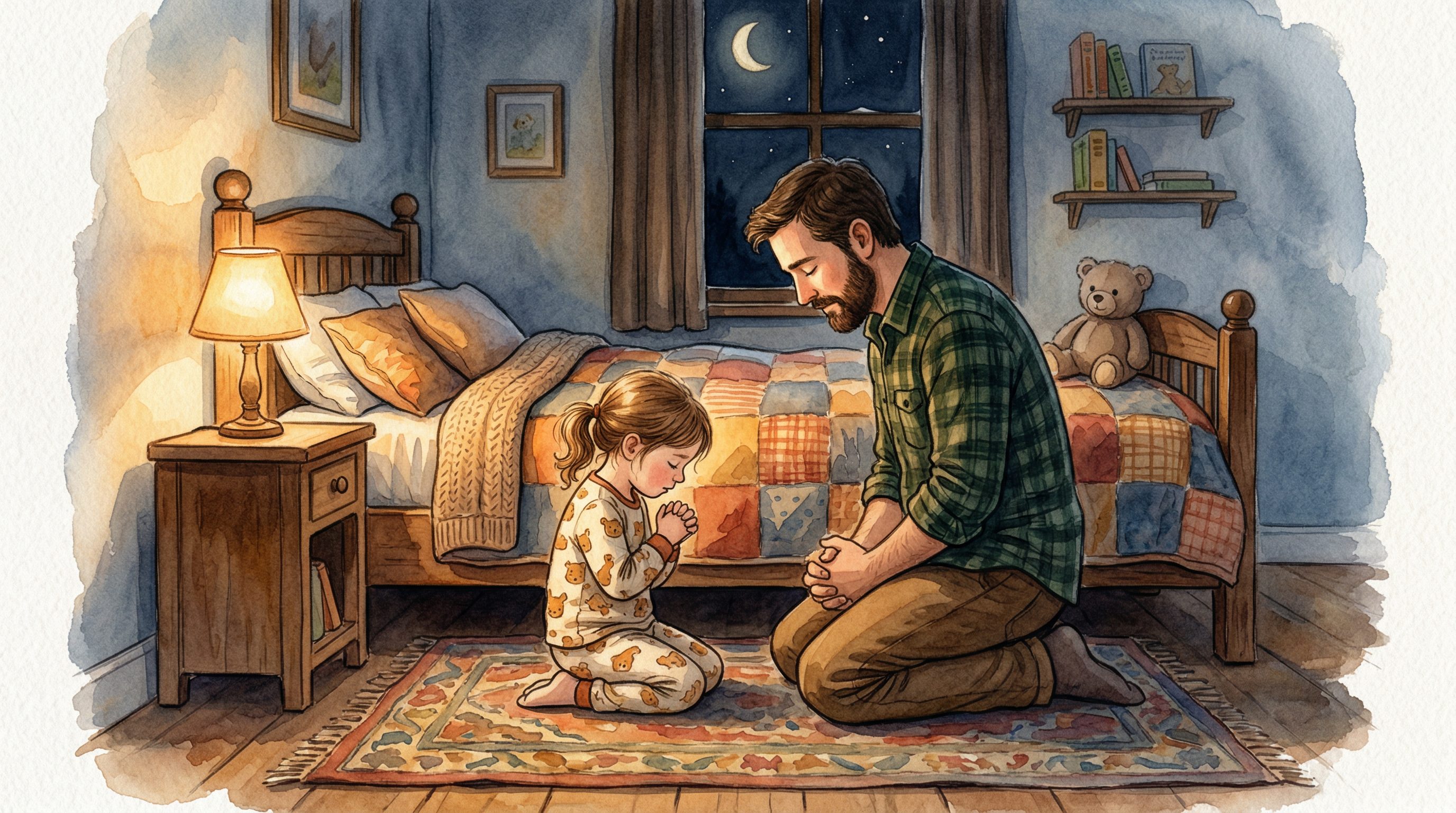
These are the questions you can't dodge, and most parenting advice on this topic is either too soft or too clinical. Dads who've navigated serious illness tell me the most important thing isn't having the right answer — it's not flinching when the question comes.
You can say: "I don't know exactly what's going to happen. The doctors are working hard. And no matter what, we are going to be okay because God doesn't leave us." That's honest. That's not a promise you can't keep. And it opens a door for more conversation instead of closing it.
If they ask why God let it happen, you don't have to have an answer. You can say: "I don't know why. I've asked that too. But I know He's still here with us, and that's what I'm holding onto." That's real. Kids can sense when you're being real with them, and it builds more trust than a clean answer that doesn't quite fit the mess.
For more on how to handle those hard questions, this article on devotionals for kids about grief has a framework that works for the whole range of hard conversations. And when kids ask the big questions about God, there's more there specifically on how to respond without shutting down their curiosity.
The Goal Isn't to Make It Okay
Serious illness isn't okay. It's scary and hard and unfair. The goal of a devotional in this season isn't to wrap a bow on something that doesn't have a bow. The goal is to keep showing up together — you and your kid, alongside whatever's happening — and to keep pointing them back to the thing that's actually stable when everything else isn't.
You don't have to do this perfectly. The nights you're too tired to do much more than read one verse and say "I love you, goodnight" — those count too. What you're building is a pattern. A posture. The understanding that even when things are hard, we still bring it to God. That's worth more than you know.
If you're looking for something to read tonight — something built for a family in a hard season — this piece on when a grandparent is sick covers similar ground and has devotional guidance for older kids and extended family situations.
Building a Simple Routine That Holds
One thing dads going through illness — their own or their spouse's — keep coming back to is the value of simplicity. When life is unpredictable, the bedtime routine becomes one of the only consistent things your kid can count on. And a devotional inside that routine becomes an anchor point: no matter what the day held, this still happens.
You don't need to be elaborate about it. The structure that works in these seasons is often the same structure every night: read one passage, ask one question, say one prayer. That's three steps. Even on the hardest nights, three steps is doable.
The question you ask matters. Avoid "how are you feeling?" — that's too open and often produces a shrug. Instead try: "What's one thing you're worried about tonight?" or "What do you want to tell God about today?" Those questions give your kid something specific to respond to, and they set up the prayer naturally.
The app makes this easier on depleted nights. Instead of figuring out what to read, you open it, read what's there, and use the built-in questions. You can also build a custom series that's designed specifically for a hard season — something that fits exactly what your family is going through, in exactly the language your kid understands. That kind of personalization makes devotionals feel less like a program and more like something that belongs to your family.
The goal isn't spiritual heroism. It's consistency. Showing up every night — imperfectly, briefly, honestly — is how you build the kind of faith infrastructure that holds when things are really hard. And if a parent is sick, things are already hard. This is the time when the pattern you've built matters most.
📖 Read This Tonight
When Things Change is a short series built for families going through hard seasons — illness, transition, fear. Read it together tonight and give your kid something to hold onto.
Get Notified When New Series Drop
We add new devotional series regularly. Sign up to hear about them first.
Join the Community