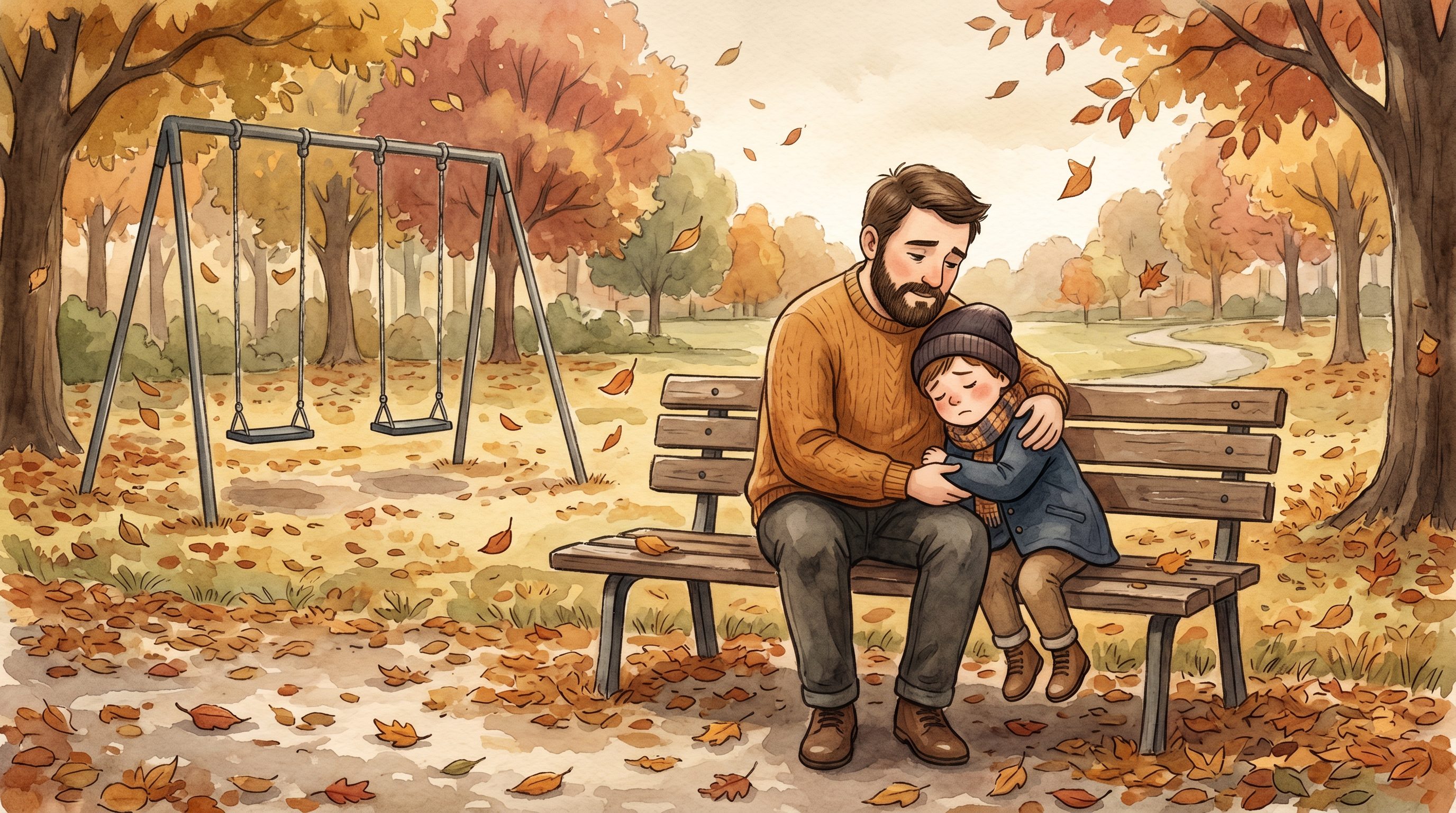
I Haven't Been There Yet. But I Know It's Coming.
I'll be straight with you: my boys are 7 and 5. We haven't lost anyone close. The grief conversations we've had so far have been about the small stuff — a fish, a hamster at school, a grandparent who passed when they were too young to really feel it. Nothing that hit the ground hard. Not yet.
But I know that's not how it stays. Every family gets there eventually. A grandparent who's been sick. A pet who was actually a member of the family. A friend from school. Something that lands differently than the fish — something where your kid looks at you with real devastation in their eyes and you have to figure out what to say in real time.
I've talked to a lot of dads who've been through it. And the thing they tell me, almost without exception: having words ready at bedtime made the difference. Not perfect words. Not the answer to why. Just something to read together, something to hold, something to say when the silence got too heavy. The dads who had a devotional framework going into that season — even a simple one — felt less helpless. Their kids felt less alone.
This article is my attempt to put together what I'd want to have ready. What I'm preparing before I need it. And if you're reading this because you are already in the middle of it — I see you. Keep reading.
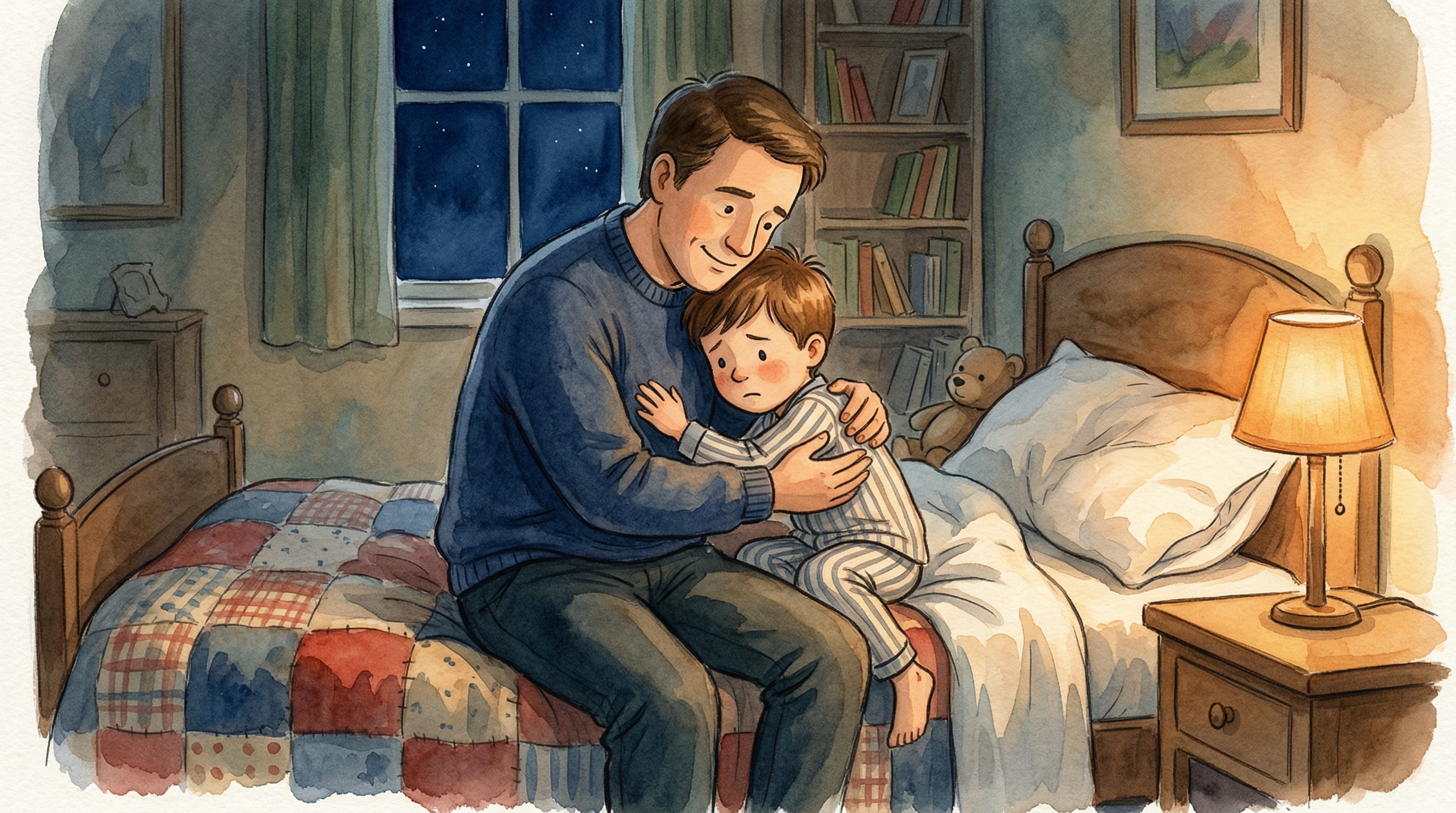
Why Grief Is Hard to Talk About With Kids
Most adults are bad at grief. We minimize it, rush past it, try to fix it. We say things like "they're in a better place" not because that's wrong, but because it's what we reach for when we don't know what else to say. We protect our kids from sadness in ways that accidentally teach them that sadness is wrong, or dangerous, or something to be solved.
Kids grieve differently than adults. They don't stay in it continuously — they might cry hard for ten minutes and then ask for a snack. That's not callousness. That's how their emotional processing works. They dip in and out. But when they're in, they need someone to be in with them.
Your presence in that moment is the thing. Not the explanation. Not the theology. Not the perfectly constructed sentence about heaven. You sitting on the edge of their bed, being willing to stay in the hard moment with them — that's what reaches a grieving kid.
A devotional gives you a shared object to look at together. Instead of facing each other across the expanse of "I don't know what to say," you're both looking at something else — a verse, a story, a question — and the conversation can grow from there without either of you having to manufacture it from nothing.
What to Actually Say at Bedtime When Your Kid Is Grieving
Start with naming. "Today was a really hard day. It's okay that it was hard." That's all. Don't add "but" to that sentence. Don't rush to the silver lining. Just name the hardness and sit in it for a beat.
Then read something. It doesn't have to be about death specifically. In fact, sometimes a devotional about being held, about God being near, about not being afraid — lands harder and truer than one that tries to address loss head-on. Your kid needs to feel the presence of God, not just understand the facts of death.
Psalm 34:18 is one of the most direct verses in the Bible about grief: "The Lord is close to the brokenhearted and saves those who are crushed in spirit." Read it slowly. Ask: "What do you think it feels like to be close to someone?" Let them answer. Then: "That's what God is doing right now. He's close. He's not far away."
Matthew 5:4: "Blessed are those who mourn, for they will be comforted." Jesus doesn't say stop mourning. He says there's a blessing in it — comfort is coming. That's a promise worth putting in a grieving kid's head before they go to sleep.
Questions to Open the Conversation
Sometimes the conversation won't start on its own. Your kid might be shut down, or too tired to start it, or not sure if they're allowed to feel what they're feeling. These questions can open the door:
- "What's one thing you miss about [person/pet]?"
- "What's a good memory you have of them?"
- "What do you think heaven is like?"
- "Is there anything you wish you could tell them?"
- "What would you want them to know about you right now?"
You don't need to answer these questions. You need to listen. The answers your kid gives will tell you where they are and what they need. Follow their lead.
If they ask you questions you can't answer — why did they have to die, is God being fair, will it always hurt this much — it's okay to say, "I don't fully know. But I know God is real, and I know He sees us, and I know this matters to Him." That's honest. That's faith. That's better than a confident answer you don't actually have.
For more on navigating those hard questions your kids throw at you — including the ones about God and death and fairness — this guide on what to say when kids ask about God covers that territory in depth.
When the Loss Is a Pet
Don't minimize this. Adults know intellectually that a pet isn't the same as a person, but a kid's grief over a pet is completely real and completely valid. For many kids, a pet is their first experience of death — and how you handle that shapes how they process loss for the rest of their lives.
The worst thing you can do is rush it. "We'll get a new one" is not grief counseling. Let them feel what they feel. Read with them. Pray with them. Give the loss weight, because it has weight.
If you're in this specific moment, this article on devotionals for when a pet dies has specific, practical guidance for that situation — including what to read and what to say on the first night.
A Framework for the First Week
Grief doesn't resolve in one bedtime. Here's a loose structure for the first week that a few dads I've talked to have found helpful:
Night 1–2: Just be present. Don't push for deep conversation. Read something short about God being near. Pray a simple prayer. Stay in the room a little longer than usual. Your presence is the whole message.
Night 3–4: Start asking questions. One question per night. Listen more than you talk. Resist the urge to fix the sadness or explain it away. The goal is for your kid to feel heard.
Night 5–7: Start looking forward, gently. Talk about the person or pet they lost — good memories, things they taught your kid, things they'll carry with them. What did they love? What made them laugh? What do you want to remember? This is how grief turns into honor. It's not moving on — it's moving forward, and bringing them with you. "Sad that they're gone" and "grateful they were here" can live in the same conversation. That's not a contradiction. That's what love looks like on the other side of loss.
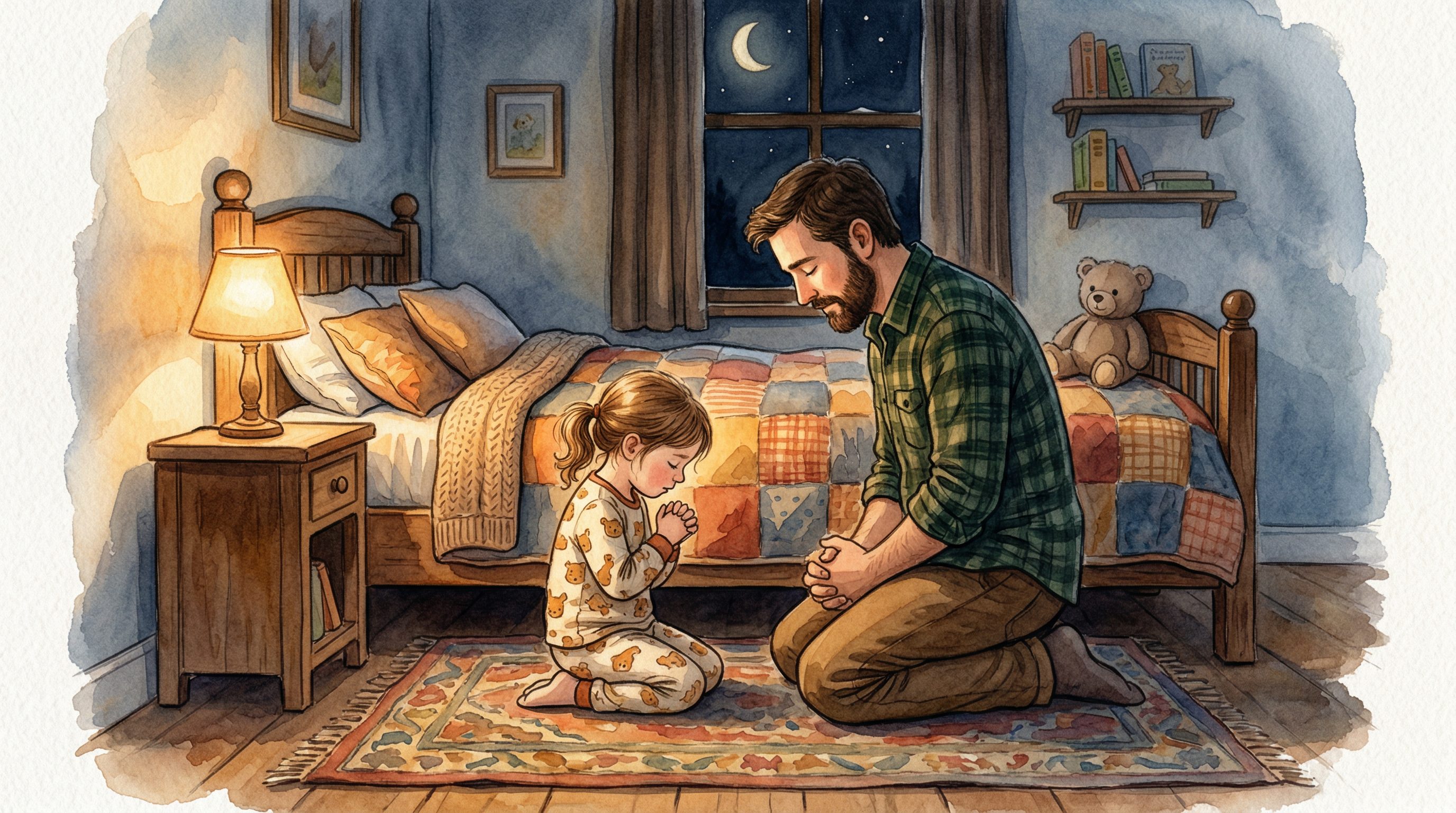
If the Loss Is Specific and I Don't Have the Words
Every loss is different. A grandparent after a long illness. A sudden tragedy. A miscarriage your kids are too young to fully understand. A friend. A divorce — which is its own kind of grief. The shape of each loss changes what's needed, and I can't write a one-size-fits-all devotional for all of it.
That's why the Create Your Own feature exists. Tell it what's happening — what you've lost, how old your kids are, what questions they're asking — and it will build a devotional designed for your specific situation. Not a generic grief devotional. One built for the loss you're actually living through.
The When Things Change series is also worth starting — it's built for seasons of transition and loss and helps kids process change with faith as the foundation.
And if you want a broader guide on how to approach the death conversation directly — what to say, how to explain it at different ages, what questions to expect — this guide for Christian dads on talking to kids about death goes deeper on that framework.
You don't have to have it figured out. You just have to show up. That's the whole job. And you're already doing it.
📖 Read This Tonight
The When Things Change series is built for kids navigating loss, transition, and the hard seasons of life. Or build a devotional specific to your family's situation with Create Your Own.
Get Notified When New Series Drop
We add new devotional series regularly. Sign up to hear about them first.
Join the Community