
The Question Came Out of Nowhere, the Way They Always Do
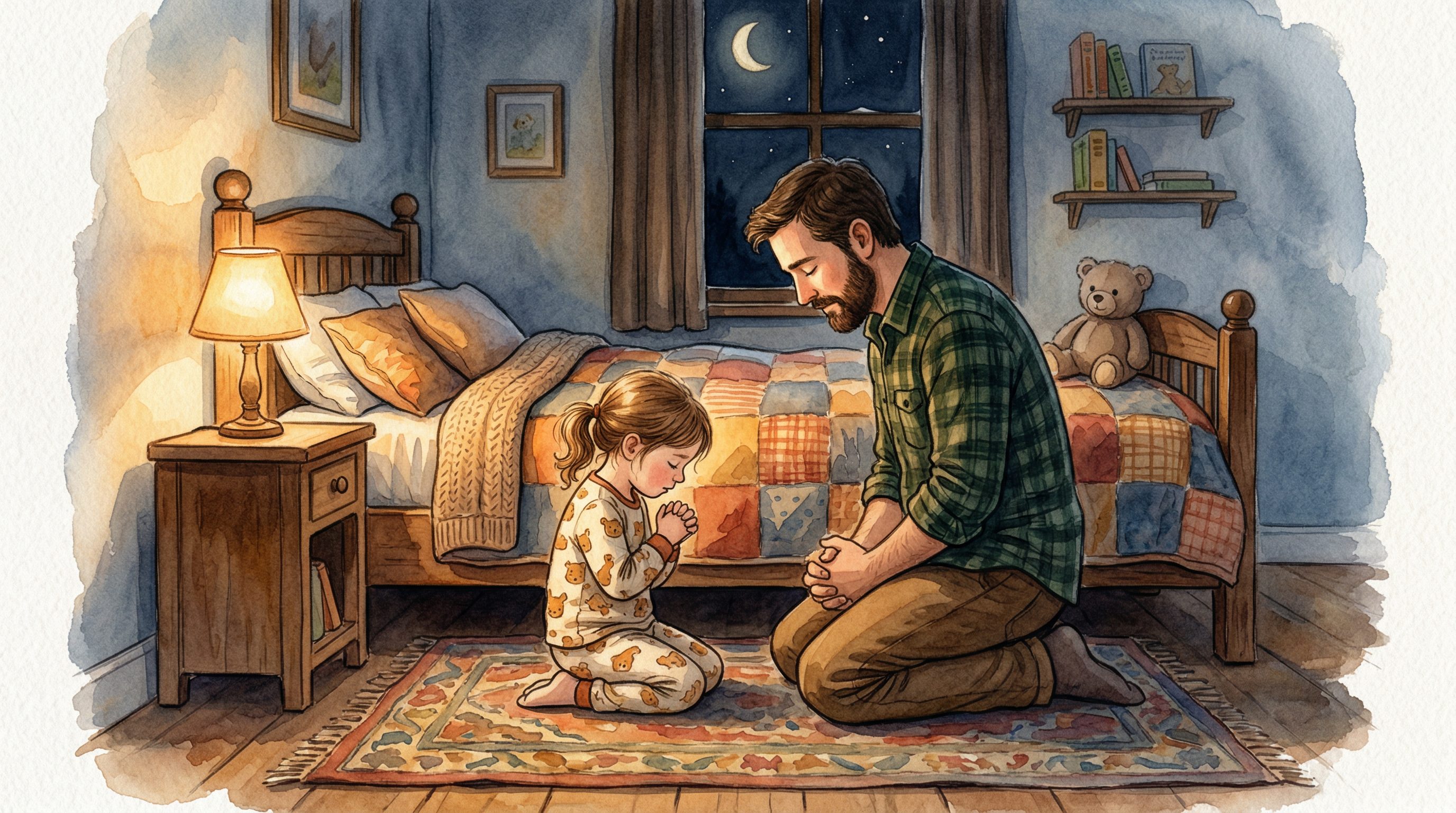
It was bedtime. We were halfway through a devotional. My son looked up at me and said, "Dad, if God can see everything, why doesn't he just stop the bad stuff?"
He was six. I was not prepared. And the thing about that question — the thing about most of the hard ones kids ask about God — is that there isn't a clean, pocket-sized answer. I knew enough to know that. I also knew that how I handled the next thirty seconds mattered more than whatever I actually said.
If you're a dad who's doing devotions with your kids — or even just having real conversations with them — you are going to get hit with these questions. Where does God live? Why does God let bad things happen? Is heaven real? Did God make the bad guys too? Why can't I see him? They come from real curiosity. They come from real worry. And they deserve a real response — not a dodge, not a performance, and not a Sunday school script that your kid can tell you don't fully believe either.
This is a guide for how to talk to kids about God when the questions are hard and you're still figuring some of it out yourself. If you want context on building the devotional habit first, start with how to do bedtime devotions with your kids.

The Honest Truth About These Conversations
Here's the thing most parenting content about faith won't say: you don't have to have all the answers. In fact, pretending you do is one of the fastest ways to lose your kid's trust on this stuff.
Kids are better at detecting inauthenticity than we give them credit for. If you give a canned answer to a real question, they know. They might not be able to articulate it, but they log it — dad just gave me the church answer, not the real one. Do that enough times and they stop bringing you the real questions.
My own faith has had seasons where it felt thin. Where the consistency wasn't there, where I was asking some of the same questions my kids were asking. And I had to sit with this: why would I tell my son this is important if I wasn't treating it that way myself? That tension is what pushed me to take it more seriously — not just for them, but for me.
The point is: you can lead your kid through hard God questions without having a theology degree. What you need is honesty, a little groundedness, and the willingness to say I don't fully know, but here's what I believe. That phrase alone is more powerful than most rehearsed answers.
The Questions You'll Actually Get
Let's go through the ones that come up most. Not with definitive answers — with a framework for how to respond in a way that's honest, accessible, and age-appropriate.
"Where does God live?"
This is usually one of the first big ones, and it comes from a very concrete place. Kids think in space. They want to know: is he in the sky? In church? Can I go there?
The answer that works best with young kids is one that uses their existing frame: God is everywhere at the same time, the same way love is everywhere at the same time. Your son understands that you love him when you're at work, when he's at school, when you're not in the same room. God is like that — always present, not stuck in one place. It's not a complete theological answer, but it's true and it's something a five-year-old can actually hold onto.
"Why does God let bad things happen?"
This is the hardest one, and there's no version of answering it that's completely satisfying — not for your kid, not for you, not for anyone. Don't try to nail it. Your goal isn't to close the question, it's to hold it with them.
Something that works: "That's one of the questions grown-ups wrestle with too. I don't have a perfect answer. What I do know is that God doesn't want people to hurt each other — that's actually the whole point of a lot of what he taught. And I believe he cares when we hurt." You're not dismissing the question. You're normalizing it, staying honest, and giving them something real to hold onto.
If your kid is anxious or worried about this kind of thing, there's more specifically on that in the article on devotionals for kids dealing with worry.

"Can God hear me when I pray?"
Most kids ask this because they want to know if prayer actually works. Behind the question is: is this real, or am I just talking to the ceiling?
The honest answer is something like: "Yes. He hears you. I believe that. Prayer doesn't always work the way we want it to — sometimes the answer is yes, sometimes it's no, and sometimes it's not yet. But talking to God is always worth doing, the same way it's always worth talking to me even when I can't give you exactly what you asked for."
The parent analogy is genuinely useful here. It's a frame kids already have context for, and it doesn't oversell prayer as a wish machine.
"Did God make me?"
This one's actually a gift. It opens the door to one of the most important things you can tell your son or daughter: you were made on purpose, by someone who wanted you to exist, with a specific set of qualities and a specific kind of life to live. That's not just a theological statement — it's an identity anchor that a kid can pull on for the rest of his life when he's wondering if he matters.
The Who Made Me series is built around exactly this question, if you want something structured to walk through together.
"Is heaven real?"
This one often comes after a pet dies, or when a grandparent passes, or just when a kid starts to become aware that people don't live forever. It carries weight. Don't brush past it.
What works: "I believe it is. The Bible talks about it as a place where there's no more sadness and we're with God. I can't show it to you the way I can show you our house, but that's part of what faith is — believing something you can't see because the evidence points that way and it feels true in your gut." You're modeling faith as a real thing, not a fairy tale, while being honest that it takes trust.
What to Do When You Get Stumped
You will get a question you have no answer for. It'll come at 8:45 p.m. when you're tired and your brain isn't at full capacity. This is not a failure. Here's what to do:
- Say "that's a good question — I need to think about that one." Then actually think about it. Come back to it the next night. "Hey, remember what you asked me last night? I've been thinking about it." Your kid will be amazed that you took him seriously enough to carry it with you.
- Think out loud. "I'm not sure, but here's where my head goes..." You're modeling how to wrestle with hard things, not just handing down answers. That's actually more valuable.
- Look it up together. If the question has a biblical angle, open a Bible or your app and look for it side by side. It normalizes going to the source and shows him that faith involves active seeking, not passive reception.
For dads still building the habit and the structure around it, this article on leading family devotions as a dad covers the practical setup.
How a Good Devotional Series Helps With This
One of the things I found when I started doing this consistently is that having a structure to follow takes the pressure off. Instead of coming up with something from scratch every night — and hoping I stumble into the right topics — a good devotional series walks into the big questions on purpose. It gives you something to read, a question to ask, and a natural opening for exactly these kinds of conversations.
The Let Me Tell You About God series is the one I'd point you to first if you want to work through the big God questions with your kid. It was designed specifically for this — introducing who God is in language that doesn't talk down to kids but still makes sense to them. It gives you the words for the nights when you're not sure how to start.
The goal isn't a kid who can recite doctrine. It's a kid who grows up knowing his dad took these questions seriously, who learned that faith isn't fragile — it can hold up under hard questions. That's a foundation that lasts.
The Right Standard for These Conversations
You're not trying to give perfect answers. You're trying to be the person your kid brings the hard questions to — instead of the internet, or his friends, or nobody at all.
If he's asking you the big questions about God at bedtime, you're already winning. Keep showing up. Keep being honest. Keep saying I don't know, but let's figure it out together.
That's how you talk to kids about God. Not perfectly. Honestly.
📖 Read This Tonight
If your kid is asking big questions about God, the Let Me Tell You About God series gives you something real to read together — language that's honest, age-appropriate, and doesn't dodge the hard stuff.
Get Notified When New Series Drop
We add new devotional series regularly. Sign up to hear about them first.
Join the Community