I Haven't Adopted. But Here's What Adoptive Dads Tell Me.
I want to be honest upfront: I haven't been through adoption. My boys came to me through a path that looked nothing like the road adoptive families walk. So I'm not going to pretend I understand what your family has navigated — the waiting, the paperwork, the emotional complexity, the moment you first held your child.
What I can tell you is what adoptive dads have told me, repeatedly, when I've asked about where the hardest conversations happen: bedtime. That's where the questions come. That's where the feelings surface. That's where the identity work starts — often years after the adoption itself.
And that's exactly why I'm writing this.
<
What "You Were Chosen" Actually Means to a Child
Parents often start with the chosen narrative, and it's a beautiful one — your child was specifically, deliberately chosen to be part of your family. That's true and it matters. But adopted kids, especially as they get older, can start to hear the other side of it: But why did someone else choose not to keep me?
Both questions are real. You don't have to resolve the tension to hold both truths. And this is where faith becomes something more than comfort language. The theological reality of adoption is woven all the way through Scripture — not as a metaphor, but as a central image of what God does with people.
Romans 8:15 says: "The Spirit you received brought about your adoption to sonship. And by him we cry, 'Abba, Father.'" This isn't about earthly adoption — it's about what God does with all of us. He brings us into a family we didn't earn and couldn't claim. He calls us sons and daughters not because of our origin but because of his choice.
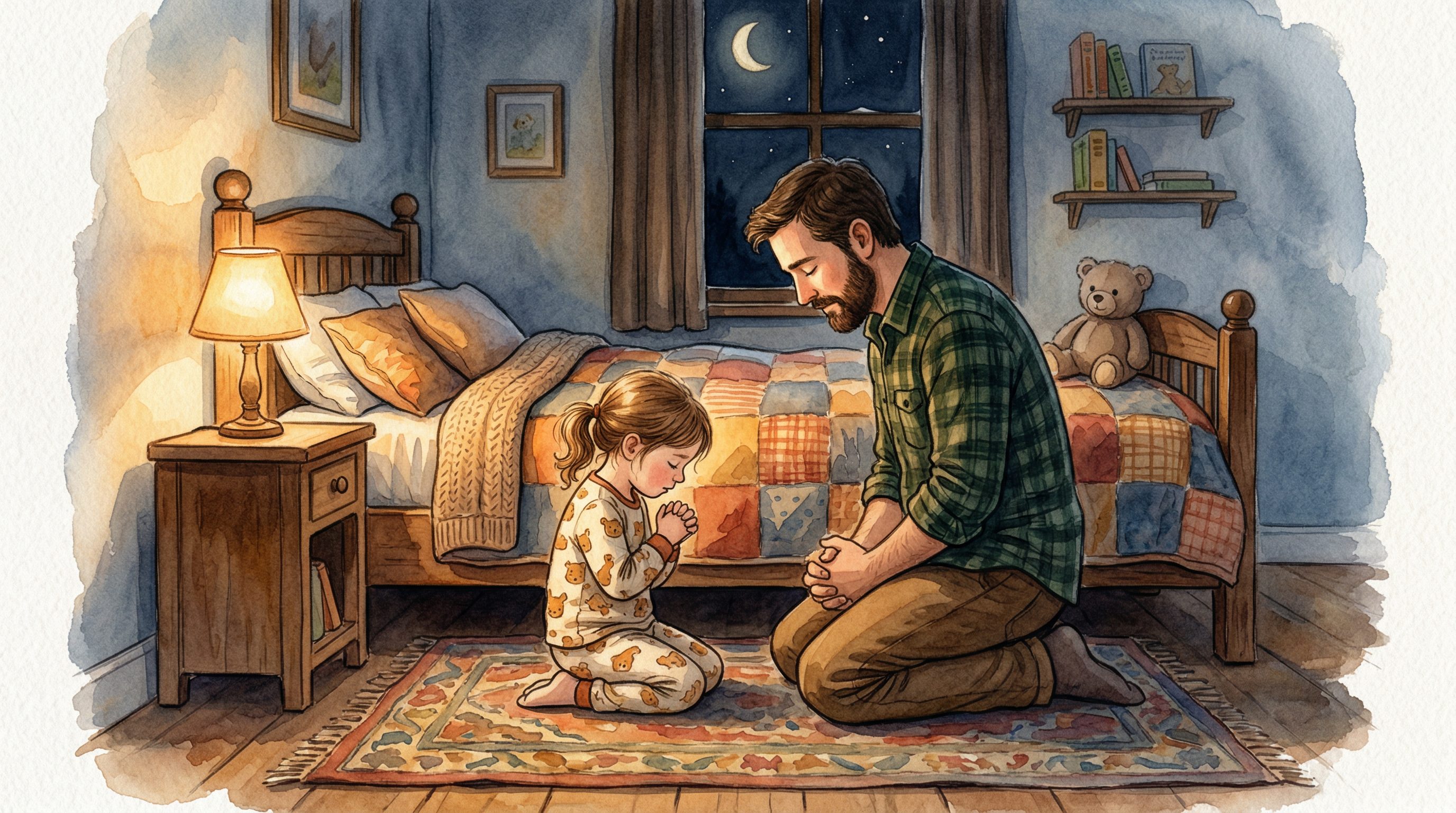
When you read that to your child at bedtime — not as a lesson, but as a shared truth — you're doing something profound. You're connecting their story to the largest story there is. They're not an exception to the way family works. They're an illustration of it.
The Bedtime Moment Is Where It Lands
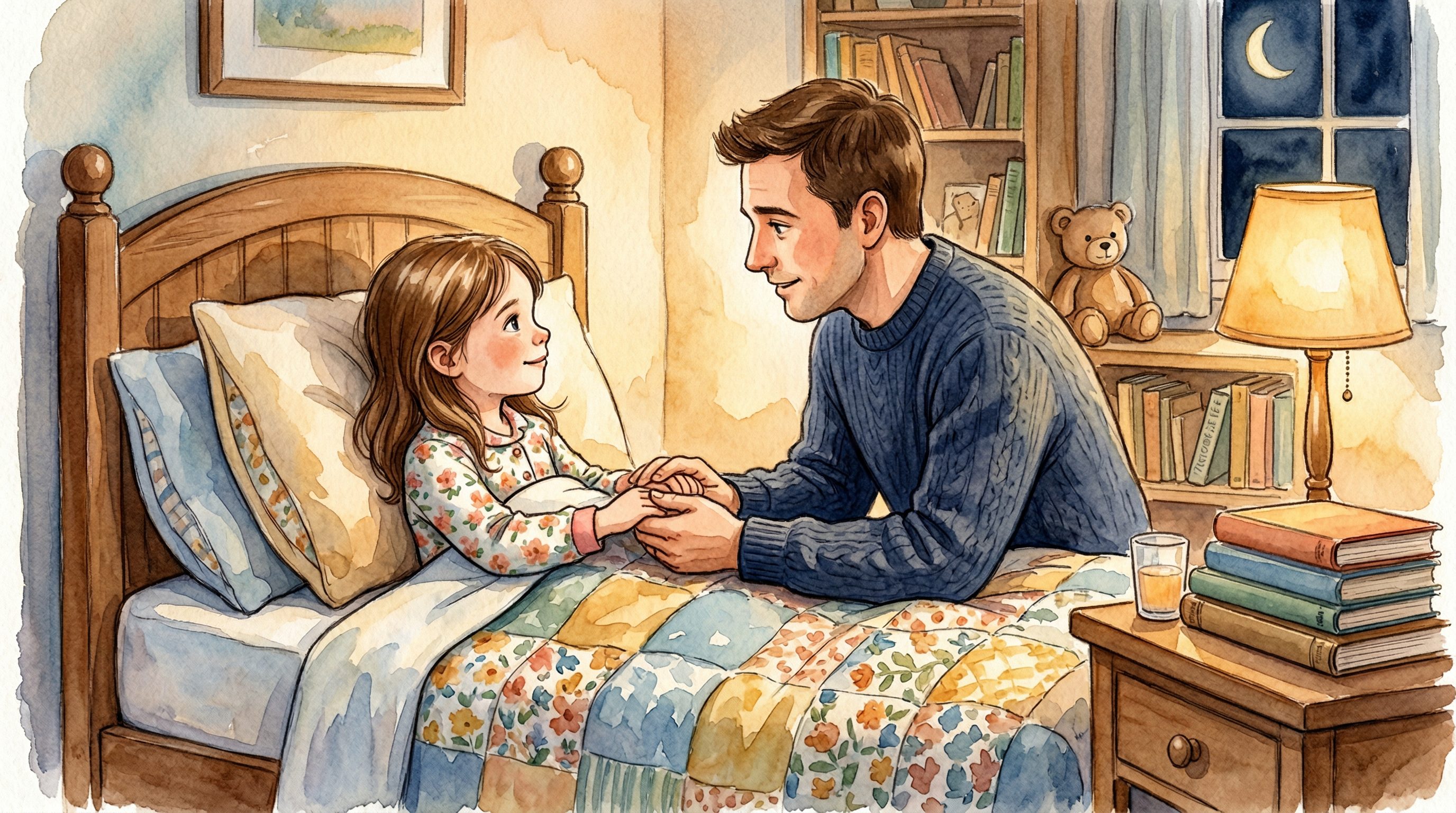
Adoptive dads consistently tell me it's not the daytime conversations that do the real work. It's the quiet moments at night, when defenses are down and the day's noise has faded, that kids actually ask the real questions.
"Do you think my birth mom thinks about me?"
"Why did God want me in this family?"
"Am I really yours?"
You can't script the answers to those questions. But you can create a space where they're safe to ask them — and where you're steady enough to hold the weight of them without flinching. That steadiness is built in the small, consistent moments. A devotional that shows up every night. A dad who doesn't avoid the hard questions. A faith that has room for the complex feelings alongside the clear truth.
If you're navigating the identity layer — who am I, whose am I, what does it mean that I'm adopted — the identity devotional article builds out that framework in more depth. And for introducing your child to a God who is explicitly defined by how he receives people, this piece on introducing your child to God gives you language for the early relational conversations.
<
What to Actually Read With Your Adopted Child
Standard devotional content wasn't written with adopted kids in mind, which means you'll need to be selective. Here's what works well:
- Identity-based content — devotionals that anchor a child's worth in who God says they are, not where they came from or what they've been through
- Belonging narratives — biblical stories of people who were grafted in, welcomed, brought home (Ruth is a powerful one; the prodigal son's return resonates differently for a child who knows what it feels like to come home)
- Chosen language — content that uses the word "chosen" specifically, and explains what it means in the context of faith, not just family
Because every adoptive family's situation is different — the child's age at adoption, the level of openness with birth family, what they've been told and when — the most effective devotional content is often the kind you shape yourself. The custom devotional builder lets you do exactly that: create a series built around your child's specific questions and your family's specific story. Adoptive dads who've used it tell me it changed what bedtime felt like.
The Questions You Can't Fully Answer
There will be nights when your child asks something you can't fully answer. Why did this happen to me. Why did God put me through this. What if they hadn't chosen me. Those are real questions and they deserve real responses — not "everything happens for a reason" and not deflection.
What works: "I don't know the full answer to that. But I know this: you're here. You're mine. And God knew your name before any of this happened."
That's not a complete answer. It's an anchor. And sometimes an anchor is exactly what's needed — not an explanation, just something solid to hold onto while the questions keep moving.
For families navigating foster care or the added complexity of foster siblings, this piece on devotionals for foster families addresses some of the same identity and belonging questions in that specific context.
<
What You're Building Over Time
The goal of devotional time with an adopted child isn't to resolve their adoption story. It's to build a faith that can hold all of it — the joy and the grief, the clarity and the confusion, the certainty of being loved and the questions that still don't have neat answers.
That's actually what faith is for. Not the easy parts. The parts that need something bigger than human understanding to carry.
You're building that for your child, one night at a time. That's not a small thing.
📖 Read This Tonight
Every adoptive family's story is different. Build a devotional series that fits yours — one that speaks directly to your child's questions about belonging, identity, and being chosen.
Get Notified When New Series Drop
We add new devotional series regularly. Sign up to hear about them first.
Join the Community