
Kids Ask the Sharpest Questions
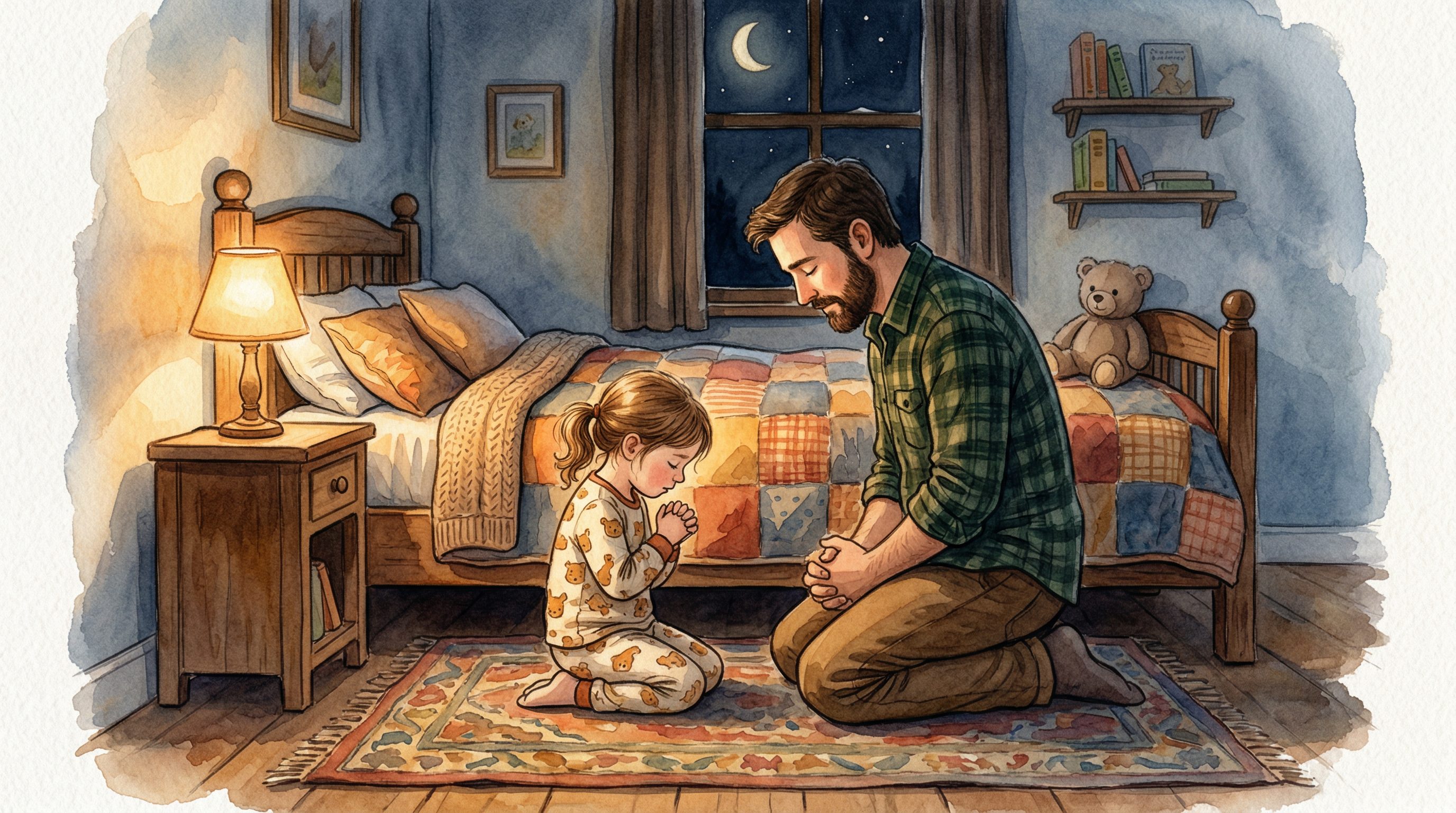
At some point your kid is going to look at you — probably at bedtime, when you're not prepared for it — and ask something that stops you cold. "Is God real?" "Why can't I see Him?" "Does God love bad people too?"
These aren't questions you can deflect. They're the questions that matter most, and how you respond shapes how your kid thinks about faith for years. The problem is that most dads were never given good language for this. Nobody walked them through it. They got Sunday school answers as a kid and they're not sure those are enough anymore.
This is a simple guide. Not a theological treatise. Just a framework for what to tell your kids about who God is — in plain, honest, dad-to-kid language that you can actually use.

Start With What Kids Can Hold
When you talk to kids about God, you have to start with concepts they can actually hold onto. Abstract theology — God as infinite, eternal, omniscient — doesn't register for a seven-year-old. What registers is personal. Relational. Concrete.
Here are the core truths to start with, and how to say them in a way that lands:
God made everything
This is the foundational starting point. Before you get into who God is relationally, help your kid understand that God is the source of everything they see. "You know how everything was made by someone — your toys, this house, your food? God made all of it. He made the whole world. And He made you."
This isn't hard for kids to grasp. They already understand the concept of a maker. You're just pointing that concept all the way back to its origin.
God is a person, not a force
Kids (and adults) sometimes drift toward thinking of God as an impersonal cosmic force — the universe, karma, "something out there." But the God of the Bible is personal. He thinks. He speaks. He loves. He acts. That distinction matters enormously — because a personal God is someone you can have a relationship with. A force is something you hope is on your side.
Try: "God isn't just a power or an energy. He's a person. He talks, He listens, He cares what happens to you specifically. He's not some far-away force — He's someone."
God loves your kid — specifically
"God loves everyone" is true, but it's abstract. "God loves you" is what lands. Tell your kid that God knows their name, knows what they're worried about tonight, knows what made them laugh today. That specificity is powerful.
"God loves you — not just people in general, but you. He knows your name. He knows you better than anyone."
God is always present
For young kids especially, the idea that God is here — in the room, on the drive to school, on the soccer field — is enormously comforting. Not because it's abstract theology about omnipresence, but because it means they're never alone.
"God is everywhere. He's here right now. You can't see Him, but that doesn't mean He's not here — same way the wind is real even when you can't see it."

What to Do With the Hard Questions
Every honest conversation about God eventually hits the hard stuff. Here are some of the most common ones kids ask, and real language for how to respond.
"Why can't I see God?"
This one's actually not that hard. "You can't see the wind, but you can feel it and see what it does. You can't see love, but you know it's real because you feel it. God is like that — you can't see Him with your eyes, but you can see Him in the things He made and feel Him when you're paying attention."
"Is God a man or a woman?"
Honest answer: "God isn't a man or a woman the way we are. He made both men and women, so He's bigger than either. The Bible mostly calls Him 'He' and calls Him 'Father,' so that's what we say too — but He's not a man exactly. He's God."
"Why does God let bad things happen?"
This is the hardest one. Don't oversimplify it. "That's one of the hardest questions there is, and really smart people have wrestled with it for thousands of years. Here's what I believe: God can bring good out of hard things, and He stays close to us when life is hard. I don't always understand why things happen. But I trust that He's still good."
The goal isn't a tidy answer. The goal is modeling how to hold a hard question with faith still intact.
"Does God love bad people?"
"Yes. That's actually one of the most important things about God — He loves people even when they mess up. He doesn't stop loving you when you do something wrong. He wants everyone to choose to love Him back, but He doesn't stop loving first."
The Character of God: Words That Help Kids
Beyond the foundational truths, here are some of God's characteristics that translate well for kids — and the language to use:
- Good: "Everything God does is good, even when we don't understand it at first."
- Fair: "God is completely fair. He sees everything — the stuff that's unfair in your life — and He cares about making things right."
- Strong: "Nothing is too hard for God. Nothing is too broken for Him to fix."
- Patient: "God is really patient. He doesn't give up on people, even when they ignore Him for a long time."
- Close: "God isn't far away. He's close. You can talk to Him right now and He hears you."
You don't have to cover all of these at once. Let them come up naturally in conversation over time.
Talking About God as Father
One of the most powerful frameworks for introducing God to kids is the father-child relationship — because it's one they already understand from the inside.
This framing works especially well with younger kids. When you say "God loves you the way I love you, but even more," you're grounding an abstract idea in something they can feel. They know what it's like to be loved by a dad. You're extending that outward.
Be thoughtful here if your family has complications — if dad is absent, if the relationship is strained. In those cases, you can still use the concept while anchoring it differently: "You know how a good dad protects his kids and always shows up? God is like that — He never leaves, never gives up, always there." You're describing the ideal, not just mirroring your specific situation.
The reason this matters: research on children's spiritual development consistently shows that kids who have a warm relationship with their father tend to find the concept of a loving, accessible God easier to grasp. As a dad, you're not just a caregiver — you're one of the primary ways your child learns what God might be like. That's worth taking seriously.
It also means that when you're honest, present, and trustworthy with your kid, you're doing more than good parenting. You're giving them a living reference point for what God's character looks like in practice.
What Not to Say
A few things to avoid when talking to kids about God:
- Don't use God as a threat. "God is watching you" said as a warning trains kids to see God as an enforcer, not a father. It damages the relationship before it starts.
- Don't fake certainty you don't have. If you have doubts, it's okay to say "I believe this, but I'm still figuring some of it out." That models a mature faith.
- Don't make it a lecture. Keep conversations short and responsive. Follow your kid's curiosity instead of delivering a prepared speech.
- Don't wait for a perfect moment. The car, the backyard, the dinner table — these are fine. Bedtime is especially good. You don't need a special setting.
Using a Devotional to Do This Well
One of the most practical moves you can make is to use content that's already done the theological heavy lifting for you. You don't have to come up with this language from scratch every night.
The Let Me Tell You About God series on Hosted Devotions was designed specifically for this — walking kids through who God is in age-appropriate language, with a dad leading the reading. It covers the foundational truths above in a way that's warm without being saccharine and honest without being overwhelming.
If you're just getting started with these conversations, this guide on introducing your child to God for the first time is a good companion — it covers how to open the door before you get into the deeper content. And for the harder questions that come up, this article on what to say when kids ask about God gives you more detailed language.
You don't have to have all the answers. You just have to be willing to stay in the conversation. That's what your kid is watching for.
📖 Read This Tonight
The Let Me Tell You About God series walks kids through who God is in age-appropriate, dad-friendly language. It's the foundation these conversations need — built for bedtime, designed to go deep without being heavy.
Get Notified When New Series Drop
We add new devotional series regularly. Sign up to hear about them first.
Join the Community