
The Prayer That Felt Like a Script
I remember the first time I asked my oldest to pray out loud. He was probably five. He folded his hands, closed his eyes, and recited something that sounded like a combination of every prayer he'd heard at church, a blessing from his grandma's house, and possibly something from a cartoon. He said "amen" and looked at me like he'd passed a test.
He wasn't talking to God. He was performing prayer. And I'd accidentally taught him that's what prayer was.
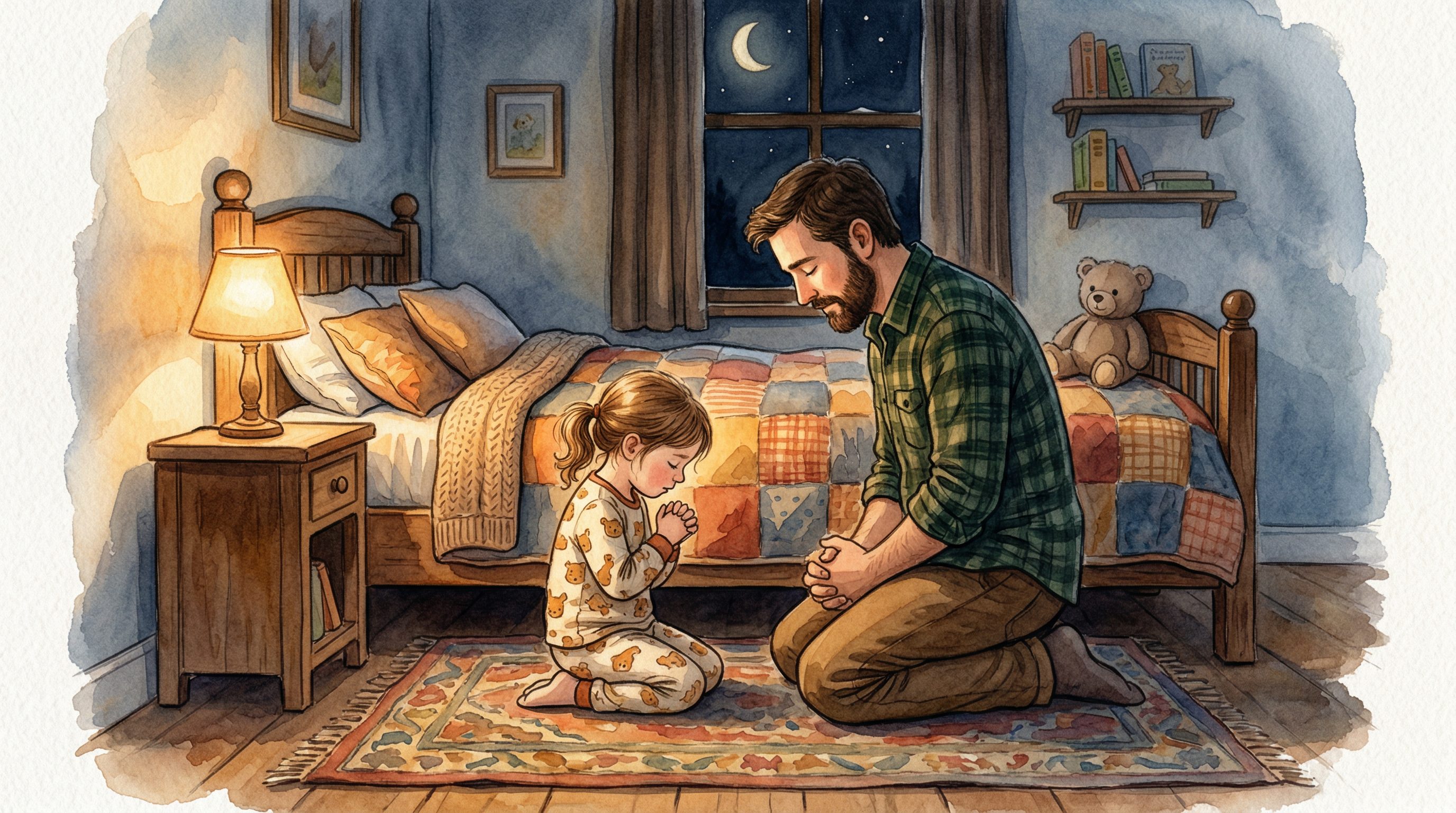
That's the problem with a lot of how we teach kids to pray. We focus on the format — hands folded, eyes closed, the right words — and we miss the thing that prayer is actually supposed to be. Teaching kids to pray without making it weird means teaching them that prayer is a conversation, not a recitation. Here's how to do it.
<
First: Understand Why Prayer Gets Weird
Prayer gets weird for kids for a few consistent reasons:
They're performing, not talking. When kids learn prayer by imitating adult liturgical language — "dear heavenly Father," "we just ask" — they're learning a dialect that doesn't match how they actually think or speak. It creates distance instead of connection.
They don't know if anyone's listening. This is the deeper issue. A kid who isn't sure God is real will pray self-consciously, like someone leaving a voicemail for a number they're not sure is active. The relational foundation matters.
They've been told there's a right way to do it. Formal prayer formats — even good ones like ACTS (adoration, confession, thanksgiving, supplication) — can make prayer feel like a test your kid might fail. That's the opposite of what you want.
Understanding these three failure modes changes how you approach the teaching. You're not drilling a format. You're building a relationship with God, mediated through conversation.
What Jesus Actually Said About Prayer
In Matthew 6, Jesus gives what we call the Lord's Prayer — but notice what he says before it: "When you pray, do not keep on babbling like pagans, for they think they will be heard because of their many words." (Matthew 6:7)
Jesus is literally telling us not to make prayer complicated. The model prayer he gives is short, direct, and covers the essentials: honoring God, aligning with His will, asking for what you need, and dealing with forgiveness. That's it. There's no performance requirement in the Lord's Prayer.
This is genuinely good news for kids — and for dads who feel like their own prayer life isn't polished enough to model. You don't have to be eloquent. You have to be real.
Another verse worth showing your kid: Luke 18:16 — Jesus welcoming children directly. The disciples tried to keep kids away from him, and Jesus said to let them come. God is not annoyed by a seven-year-old's rambling prayer about their Lego set. He's listening.
<
Practical Ways to Teach Prayer at Bedtime
Here are the methods that actually work — tested on real kids, not theoretical ones.
Model First, Teach Second
The most powerful thing you can do is pray naturally in front of your kid, regularly, starting when they're young. Not formal prayer. Conversational prayer. "God, thank you for the good day. Help my boys sleep well. I'm worried about this thing at work — I'd appreciate some help with it." Out loud, at normal volume, in normal sentences.
When your kid hears you pray like a person instead of like a liturgical robot, they learn that this is what prayer sounds like. They'll imitate the same register.
Use the "Talk to God Like a Friend" Frame
Tell your kid directly: "God already knows everything about you. Prayer isn't telling him new information — it's having a conversation with someone who already loves you."
Then ask: "What would you tell a really good friend about your day?" Let them answer. Then: "That's basically what prayer can sound like." This reframe works surprisingly well with kids ages 6–10. It removes the performative element and replaces it with something they already understand — conversation.
Start With Gratitude, Not Requests
Most kids learn to pray by asking for things — which isn't wrong, but it trains an incomplete view of prayer. Start gratitude-first. Ask your kid to name one good thing from the day before they ask for anything. This shifts the posture from transaction to relationship.
Over time, you can introduce other modes: sorry prayers (confession without guilt-spiral), help prayers (petitions), and listening prayers (just being quiet for a moment). But start with gratitude. It's the most accessible and the least weird.
Give Them Sentence Starters
For younger kids who don't know how to begin, sentence starters are incredibly useful. Not scripts — starters. Something to open the door:
- "God, today I'm thankful for..."
- "I'm sorry about..."
- "I'm worried about... Can you help?"
- "I don't understand why... but I trust you."
You can write these on an index card and let your kid pick one each night. As they get more comfortable, the card becomes less necessary. Eventually they won't need it at all.
Don't Correct the Content
This is a hard one. Your kid prays for something you think is silly or theologically imprecise. Don't correct it — at least not in the moment. Let them pray. Let it be their words. Theological refinement can come later, in conversation, not mid-prayer.
The goal at this stage isn't a perfectly structured prayer. The goal is a kid who believes prayer is a real thing they're allowed to do. That foundation is worth protecting.
What to Do When Your Kid Doesn't Want to Pray
Some nights, your kid won't want to. That's fine. Don't force it. Forced prayer produces reluctant performers, not people who actually want to talk to God.
Instead: you pray. Out loud. Briefly. Include them without requiring them. "God, thank you for my kid. He had a hard day and I don't totally know why, but you do. Help him feel better tomorrow." Done.
A kid who hears their parent pray for them, even when they didn't participate, is watching something real. That moment may land harder than any structured prayer lesson.
For a full series specifically built around prayer conversations at bedtime, the Talking to God series on Hosted Devotions walks through prayer in a way designed for real kids with real questions. It's structured enough to give you something to follow, personal enough to actually work.
<
The Long Conversation About Unanswered Prayer
At some point — probably sooner than you expect — your kid is going to pray for something and it won't happen. A sick pet that dies anyway. A conflict at school that doesn't resolve. A grandparent whose health doesn't improve.
Don't have that conversation unprepared. The basics: God hears every prayer. He doesn't always answer the way we expect. "No" and "not yet" are answers. We trust His judgment even when we don't understand it. That's not a satisfying answer for a grieving child, and you shouldn't pretend it is. But it's the true one, and kids can handle truth delivered with love.
For ideas on how to continue these conversations as part of a regular devotional rhythm, the bedtime prayers guide for dads and teaching kids prayer as conversation are both worth reading alongside this one. They cover the practical side of what to say and how to structure the nightly prayer habit in ways that grow with your kid.
The guide on what to say when kids ask about God also helps here — because once prayer becomes real, the questions follow.
The Point Is the Relationship
Teaching your kid to pray is one of the most significant things you'll do as a father. Not because prayer has to be elaborate or perfectly executed, but because you're introducing your child to a relationship that can carry them through things you won't be there for.
That's the long view. Tonight, it's just ten minutes at bedtime. But those ten minutes, accumulated over years, build something. Start simple. Stay consistent. Let it be real.
What Your Own Prayer Life Teaches Without a Word
There's a version of this conversation where you focus entirely on your kid — their prayer life, their openness, their growth. But honest dads know the real question hovering in the background: What does my kid see me doing?
I had a stretch where my faith consistency felt thin. I was going through the motions at bedtime — reading the devotional, asking the questions — but my own prayer life was sporadic at best. And here's the thing: my boys couldn't have articulated it. But they could sense it. Kids have a detector for authenticity that's more accurate than any theology test.
That's partly why I started doing my own reading in the mornings, before anyone else was up. Not because I had to, but because I needed something real to bring to the bedtime conversation. You can't give what you don't have. A dad who prays — genuinely, privately, not just performatively at mealtimes — raises kids who understand that prayer is for real life, not just special occasions.
You don't have to be a prayer warrior. You just have to be real. Pray briefly. Pray specifically. Let your kids hear you occasionally. That's the curriculum. Everything else is commentary.
📖 Read This Tonight
The Talking to God series is built specifically to help kids understand prayer as a real conversation — not a performance. It's one of the most practical series in the library for where you are right now.
Get Notified When New Series Drop
We add new devotional series regularly. Sign up to hear about them first.
Join the Community