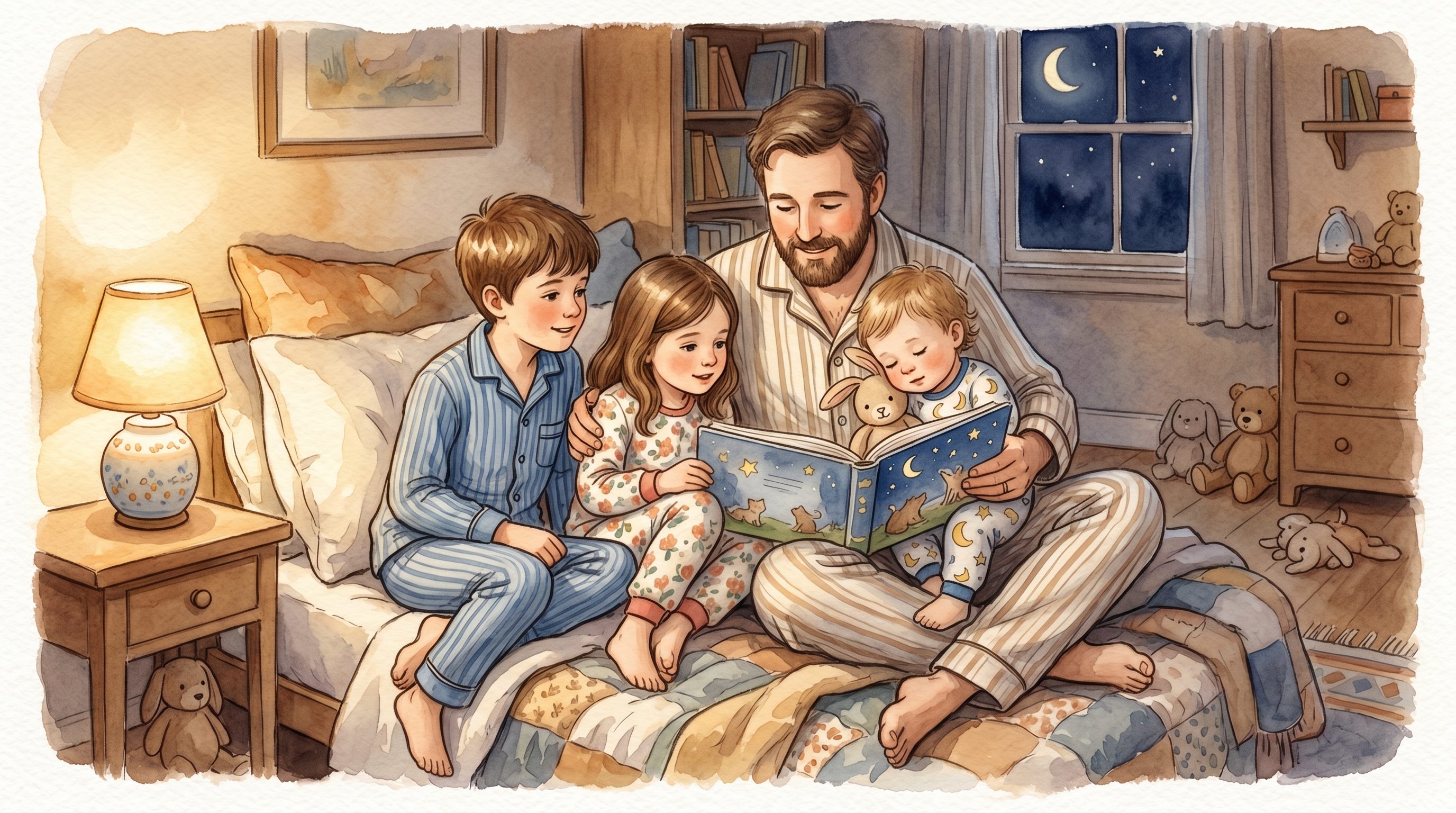
Reading to Two Kids at Once Is Not the Same as Reading to One
My boys are 7 and 5. Two years apart — close enough that you'd think doing devotions together would be simple. Same room, same dad, same fifteen minutes before bed.
Here's what I actually learned: a 7-year-old and a 5-year-old are not in the same cognitive zip code. One is tracking the story, asking real theological follow-ups, and waiting for me to dig into something. The other one just wants to know if the lion ate the man and can he see the picture again.
If you have multiple kids at different ages and you're trying to do devotions together — this is the real challenge. Not finding the time. Not knowing what to say. But figuring out how to hold the room when your kids need completely different things from the same moment.
Here's what actually works.
The Case for Reading Together Anyway
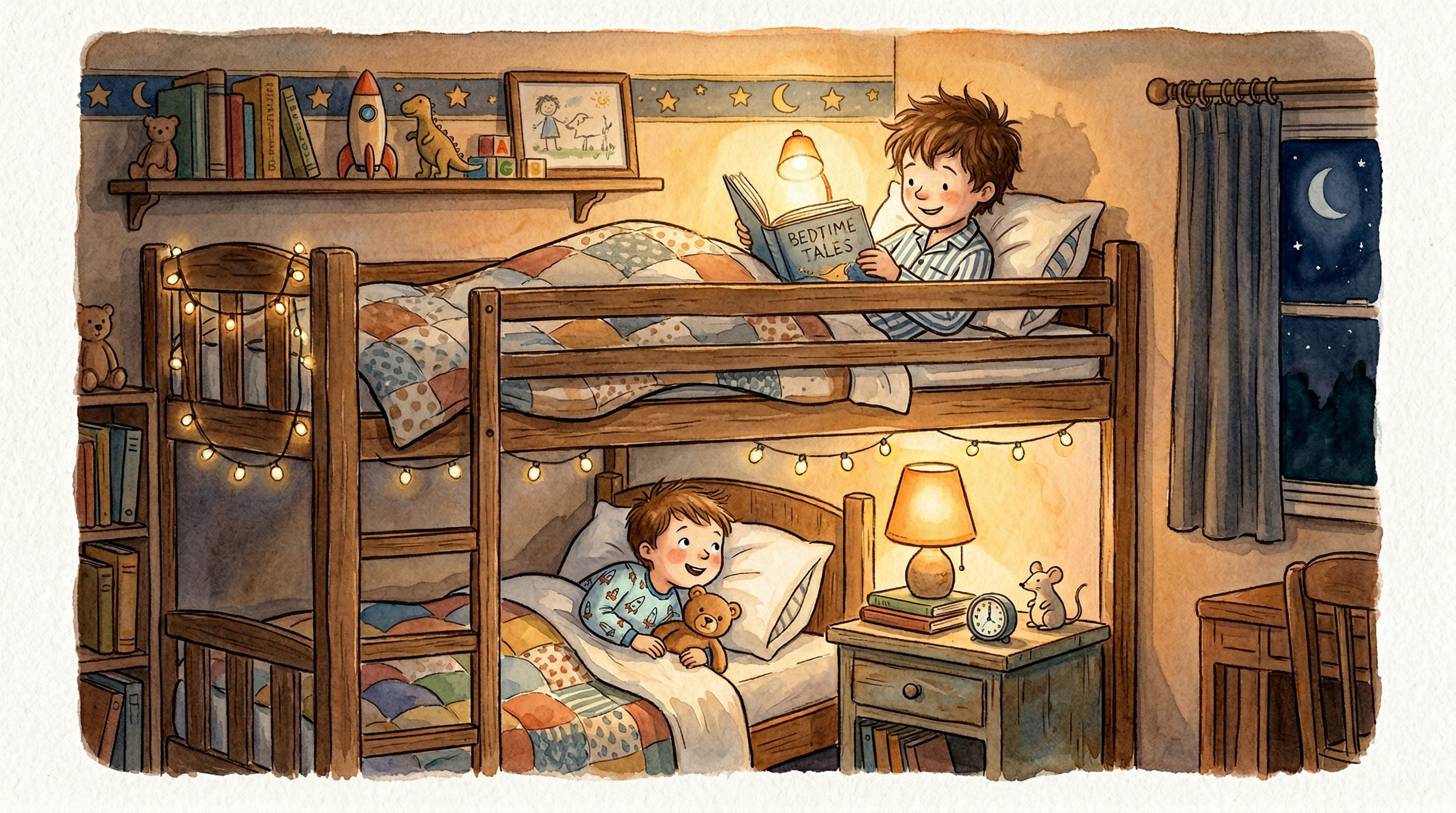
First — it's worth doing, even when it's messy. The family devotional is one of the few moments in the day where your kids are watching you take faith seriously, together. The older one is watching the younger one learn. The younger one is watching the older one engage. They're both watching you. That dynamic has its own value, separate from how much content anyone retains.
Beyond that, there's something powerful about being shaped by the same stories at the same time. Your kids will grow up remembering those conversations together. They'll reference them with each other. You're building a shared language and a shared history — and that's worth some of the logistical messiness.
That said — logistics matter. Messy is fine. Chaotic and ineffective is a different thing. Here's how to actually make it work.
The Two-Layer Approach
This is the single most useful framework for multi-age devotions. Every reading has two layers:
Layer 1 — the story itself. Concrete, narrative, sensory. Characters, conflict, what happened next. Every kid in the room can engage with this layer, regardless of age. A 3-year-old and a 10-year-old can both track a story about David and Goliath.
Layer 2 — the meaning and application. Why it matters, what to do with it, how it connects to real life. This is where you dial the conversation to each kid individually.
When you tell the story, tell it for everyone. When you shift to discussion, direct different questions to different kids based on where they are.
For the younger one: "What was the scariest part? How do you think David felt when he saw the giant?" Simple, feeling-based, concrete.
For the older one: "Why do you think David wasn't scared? What does it mean that he trusted God? Have you ever had to trust God about something?" Conceptual, reasoning-based, connecting to their life.
Same story. Same room. Different conversations. Everyone gets something.
What to Do With the Squirmy One
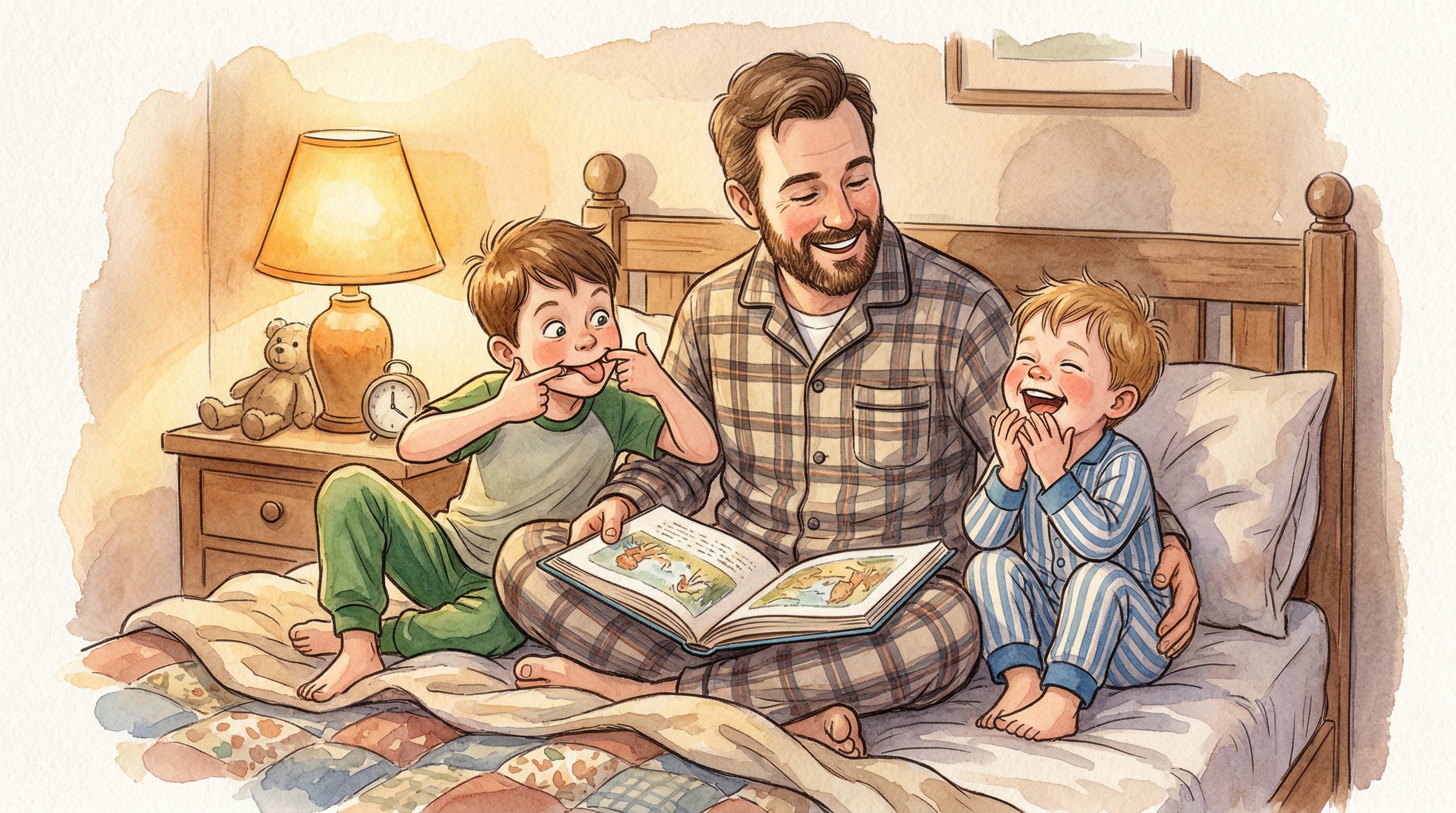
Every family has one. The kid who cannot sit still. Who is upside down on the bed three minutes in. Who asked about dinosaurs when you were talking about Moses.
A few things that help:
Give them a job. They can hold the book. They can turn the pages. They can be in charge of the prayer. Engagement drops when they feel like a bystander. Give them a role and they'll stay in it longer.
Ask them first. Whatever your opening question is, start with the younger or squirmier kid. They're more likely to engage at the beginning than after their sibling has already answered everything. Once they've had their moment, they'll stay more present.
Let them be a little fidgety. A kid who's playing with a Lego brick in their lap is not the same as a kid who's checked out. Sometimes hands need to do something for the ears to be open. Don't over-correct physical restlessness if the attention is actually there.

When the Older Kid Dominates
The flip side. Your older kid is engaged, has opinions, wants to talk about everything. Your younger kid can't get a word in. The 5-year-old shuts down because the 7-year-old answered before they could even process the question.
This happens in our house. My older one knows more, moves faster, and will fill every silence if I let him.
What I've learned: protect the younger kid's turn explicitly. "I want to hear from your brother first." Or ask the younger one a different question entirely — one that plays to what they know, not what they're still learning. "Which part of the story did you like best?" is a great equalizer because it doesn't have a right answer. Everyone's answer is valid.
You can also let the older one have their deeper conversation separately, after the younger one is asleep or before they come in. Five extra minutes of intentional conversation with your older kid can carry a lot. It doesn't all have to happen in the same window.
Adapting the Content Without Doing Double the Work
The goal is one reading that serves both kids — not two separate devotionals on the same night. Here's how to pick content that works across ages:
Choose story-driven content over concept-driven content. Stories land for every age. A lesson about patience delivered as a paragraph of instruction is hard for a 5-year-old. The same truth embodied in the story of Joseph waiting years in prison lands for both a 5-year-old and a 7-year-old — they just take different things from it.
Choose content that has a clear emotional anchor. If a reading connects to a universal feeling — fear, loneliness, wanting to belong, being proud of something — you can direct the discussion toward that feeling and both kids will find an entry point.
Check out the piece on how to do bedtime devotions with your kids for the full framework on structuring the routine itself. And when you're trying to keep things interesting across age ranges, the post on how to make family devotions fun has specific techniques that help with the engagement piece.
For the story content specifically — building out a library of stories that work for multiple ages — the guide on teaching kids Bible truths through narrative is a good resource.
A Real Example From Our Bedtime
Here's what a typical night looks like with a 7-year-old and a 5-year-old in the same room:
I read the night's passage out loud — usually one of the series on the app, about five minutes. Both boys are on the bed. The 5-year-old is leaning against me. The 7-year-old is usually sitting up, already thinking.
After the reading, I ask my younger one first: "What was your favorite part?" He tells me. Sometimes it's a detail I didn't even think was significant. Then I ask my older one the heavier question — the "why" question, the one that requires reasoning. He engages with it.
Then I bring them back together for prayer. Everyone gets to say something. Sometimes the 5-year-old prays for his stuffed animal. That's fine. It's real.
The whole thing is twelve minutes on a good night. Sometimes shorter. The point isn't perfection — it's presence. They're both there. I'm there. Something true is happening.
Handling the Age Gap When It's Bigger
Two years is manageable. But what about when you have a 10-year-old and a 4-year-old? Or a teenager and a kindergartner?
Wider gaps require more intentional splitting. You might do the first five minutes together — the story, the opening question — and then let the older kid go to bed on their own while you stay with the younger one for prayer and any lingering questions. Or flip it: tuck the younger one in first, then go back to the older one for a deeper conversation.
You don't have to do everything at exactly the same time in the same room. The shared moment matters, but so does meeting each kid individually. Some nights the family reading is the whole thing. Other nights it's just the opening act, and the real conversation happens one-on-one after.
The Thing That Actually Makes It Work
You. Showing up consistently. Not perfectly — just regularly. The multi-age devotional is always going to be a little ungainly. Someone's going to ask an off-topic question. The younger one's going to fall asleep early. The older one's going to be distracted by whatever happened at school today.
That's not failure. That's family. Keep going anyway.
If you're looking for content that actually adapts well across ages, the full series library has options for different ages and topics — browse it and see what fits where your kids are right now. You can always mix and match as they grow.
The commitment to keep showing up together, even when it's imperfect, is the thing that builds something lasting. Your kids will remember less about what you read and more about the fact that you came back every night.
📖 Read This Tonight
Browse the full series library to find content that fits where each of your kids is right now — and start building that shared rhythm tonight.
Get Notified When New Series Drop
We add new devotional series regularly. Sign up to hear about them first.
Join the Community