The Day After Changes Everything
I haven't lost a parent. And my boys are 7 and 5 — they haven't lost a grandparent yet either. I'm aware that puts me outside this experience in a real way. But dads who have navigated this — who've had to sit down with their kids the day after Grandma or Grandpa died and figure out what to say — they've told me things that stick with me.
The first thing they almost always say: I didn't know grief could feel so disorienting when it's your kid's grief, not just your own. You're trying to process losing a parent while also being fully present for your child's first real encounter with loss. It's one of the hardest things a dad can be asked to do.
The second thing they say: having something to read together — even something short, even imperfect — gave the nights structure when nothing else had any. A devotional becomes an anchor when everything else feels like water.
What Grief Actually Looks Like in Kids
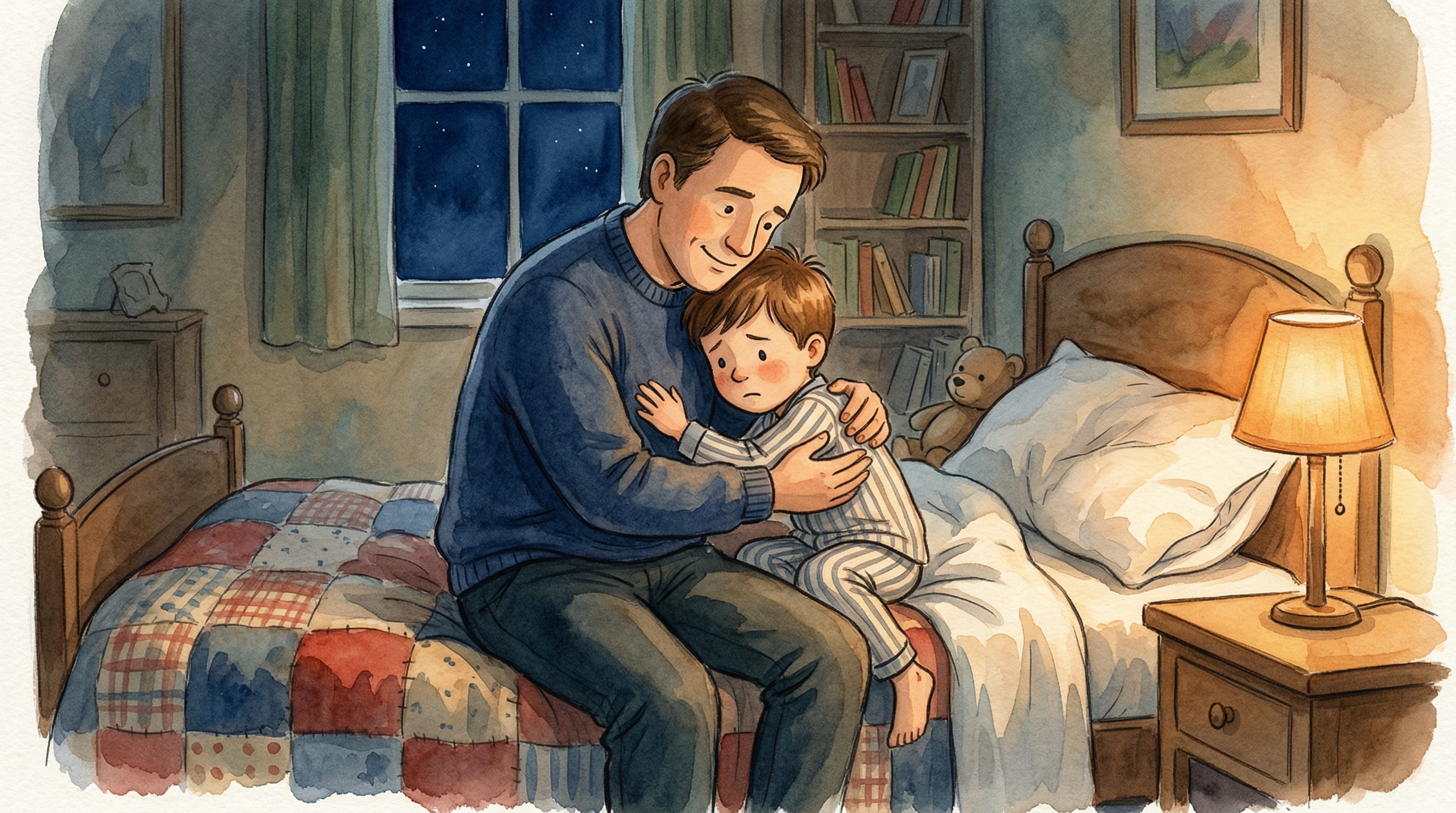
Kids don't grieve the way adults do. Adults often go through extended periods of sadness, withdrawal, and processing. Kids grieve in waves — crying hard for ten minutes and then asking if they can go play. This isn't them not caring. This is how child psychology works. Their systems can only hold the weight of grief for so long before they need to set it down temporarily.
What this means practically: don't interpret your kid bouncing back quickly as a sign they're fine. And don't interpret sudden breakdowns weeks later as a sign something's wrong. Both are normal. What they need isn't a constant state of sadness — they need a safe, recurring space where grief is expected and welcome. Bedtime devotions can be that space.
A few things dads who've walked through this report seeing:
- Younger kids asking factual questions about death — where did Grandma go, can she see us, will she come back. They need simple, honest, faith-grounded answers, not avoidance.
- School-age kids sometimes feeling guilty for feeling okay, or guilty for laughing at something. They need to hear that it's okay to feel different things at different times.
- Older kids sometimes pulling back and not wanting to talk about it. They need a lower-pressure way to stay connected — reading something together rather than a direct conversation works better.
The Hard Conversations You Can't Avoid
"Where is Grandpa now?" "Can he see me?" "Is he happy?" These are the questions that feel impossible to answer perfectly, and most dads instinctively either over-explain or shut the conversation down. Both are understandable. Neither helps.
What actually helps: answer honestly from your faith, admit what you don't know, and stay present in the uncertainty with them. You don't need to have a theological dissertation prepared. You can say: "I believe Grandpa is with God now. I believe he's not in pain and he's not alone. I don't know exactly what it looks like, but I know God keeps His promises — and one of those promises is that death isn't the end."
That kind of answer does a few things at once. It's honest — you're not pretending certainty you don't have. It's grounded — you're pointing to something real. And it keeps the conversation open instead of shutting it down.
This guide on devotionals for kids about grief goes deeper on language and frameworks for these conversations. And talking to kids about death has specific scripts for different ages that a lot of dads have found helpful.
How to Structure Devotions in the Days and Weeks After Loss
The immediate aftermath — the days right after a grandparent dies — is not the time for a lengthy devotional. Keep it short and grounded. One verse. One thing you loved about Grandma. One prayer. That's it.
As the weeks pass and raw grief settles into something more like sadness, you can expand into a longer pattern. A few principles that dads have shared:
Make space for memory. Start each session by asking: tell me one thing you remember about Grandpa. This isn't wallowing — it's honoring. And it keeps the relationship alive in your kid's mind in a healthy way.
Read something specifically about hope. Not the "everything will be fine" version of hope. The biblical version — which is forward-looking, honest about loss, and grounded in something beyond circumstances. When Things Change is designed for exactly this kind of season.
Let your kid pray whatever prayer they want. Don't correct the theology in the moment. If they pray "God, tell Grandma I miss her," let that stand. You can have a gentle conversation about how prayer works another time. In the moment, the act of them bringing their grief to God is the thing that matters.
Don't skip the nights they seem fine. The regularity of devotions matters most after a loss. The nights your kid seems okay and doesn't want to talk about Grandma — still do it. It tells them: this time belongs to us, no matter how we're feeling tonight.
Verses That Speak to This Kind of Loss
Revelation 21:4 — "He will wipe every tear from their eyes. There will be no more death or mourning or crying or pain." For kids who are sad about Grandpa being gone — this is the promise. Not just that things will be okay, but that every tear gets addressed. That God notices every one.
1 Thessalonians 4:13-14 — "Brothers and sisters, we do not want you to be uninformed about those who sleep in death, so that you do not grieve like the rest of mankind, who have no hope." For older kids who can engage with this: the passage doesn't say don't grieve. It says don't grieve without hope. Grief and hope can coexist.
Psalm 34:18 — "The Lord is close to the brokenhearted and saves those who are crushed in spirit." Short. Specific. True. For a kid who's hurting: God doesn't stay at a distance when we're sad. He moves closer.
John 11:35 — "Jesus wept." Two words. The shortest verse in the Bible. But for a kid who's afraid that sadness is wrong — that they shouldn't cry — this is everything. Jesus stood at the tomb of his friend and cried. Grief is not a failure of faith.
How Long to Keep Going
Dads ask this more than almost anything else: how long should we keep doing grief-focused devotions? When is it time to move on?
The honest answer is: there isn't a clean line. Grief doesn't end, it just changes shape. What most dads find is that after two to four weeks of more focused attention on loss, the cadence naturally shifts back to broader devotional content — but the conversations about Grandma or Grandpa keep coming up organically for months, sometimes years.
That's the goal — not closure, but integration. Grandpa becomes part of your family's ongoing conversation. You mention him at dinner. You tell his stories. You keep his memory alive. And occasionally a devotional brings it up again — a verse about heaven, a topic about love — and your kid gets to grieve a little and feel connected a little, all at once.
If you're in the earlier stages and a grandparent is still sick, this piece on when grandparents are sick has guidance for that season. The patterns you build before loss make the after a little easier to navigate.
You're Building Something That Outlasts the Loss
I wake up before my boys to do my own reading. It's the only quiet I get in the day. But the reason I started doing it — the reason I take it seriously — is that I want my sons to see, across a lifetime, that their dad believed this stuff enough to live it. That when things got hard, he didn't just quote Bible verses. He sat with the hard things and brought them to God and kept going.
When your kid loses a grandparent, and you sit with them at bedtime and read something and pray something and don't pretend it's okay when it isn't — you're doing exactly that. You're showing them what it looks like to grieve with faith. That's not a small thing. That's a legacy.
What to Do When the Loss Comes Back Up
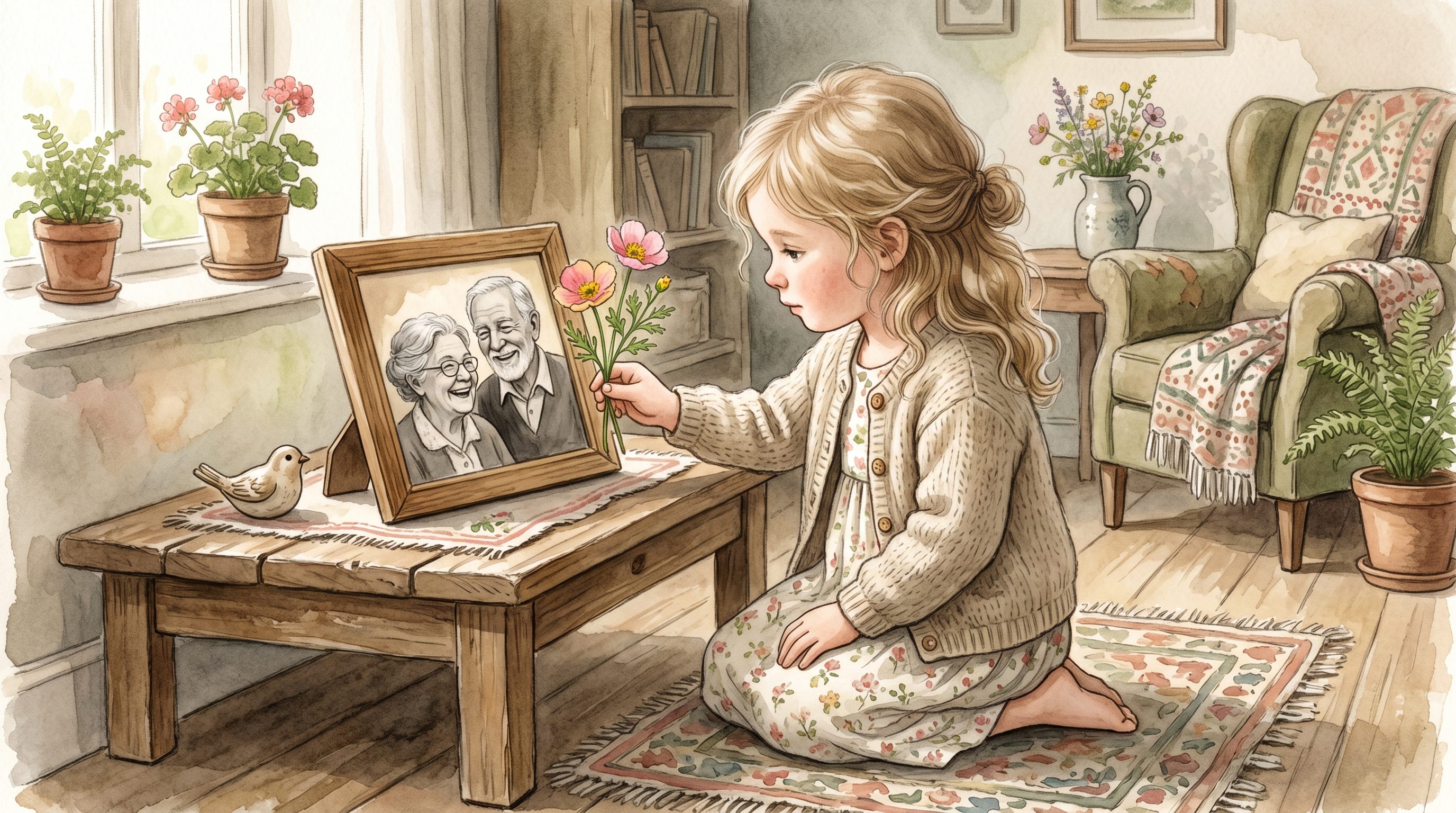
Grief doesn't follow a schedule. You'll have weeks where things feel stable, and then something will surface it again — a holiday, a birthday, an ordinary Tuesday when your kid finds an old photo. These moments are not regression. They're grief doing what grief does: processing in waves, not in a straight line.
What matters in those moments is that your kid has somewhere to bring it. This is where the consistency of bedtime devotions pays off in a way that's hard to quantify. When a wave of grief surfaces six months after Grandma died, and your kid knows that tonight there's a space to bring it — that the devotional time is safe for this kind of thing — they're far more likely to name it than to carry it quietly.
Some practical things for those moments: let the planned devotional go, and just ask your kid what they're feeling. Give them ten minutes to talk. Then pray specifically for what they brought up. You don't always need to be reading something to have a devotional moment — sometimes the devotional is just being present and bringing it to God together.
If your family doesn't have an established practice yet and a grandparent has recently died, it's not too late to start one. You can build a custom devotional series specifically designed around loss and grief — one that uses language your kid understands and addresses the exact questions they're carrying. Starting now, in the middle of grief, is better than waiting for things to feel stable first.
What you're building is a family with a reflex for bringing hard things to God. That reflex will serve your kid in every hard season they face for the rest of their life — not just this one.
📖 Read This Tonight
When Things Change is a devotional series for families facing loss, transition, and hard seasons. Short nightly entries that give your kid language for grief and something solid to hold onto.
Get Notified When New Series Drop
We add new devotional series regularly. Sign up to hear about them first.
Join the Community