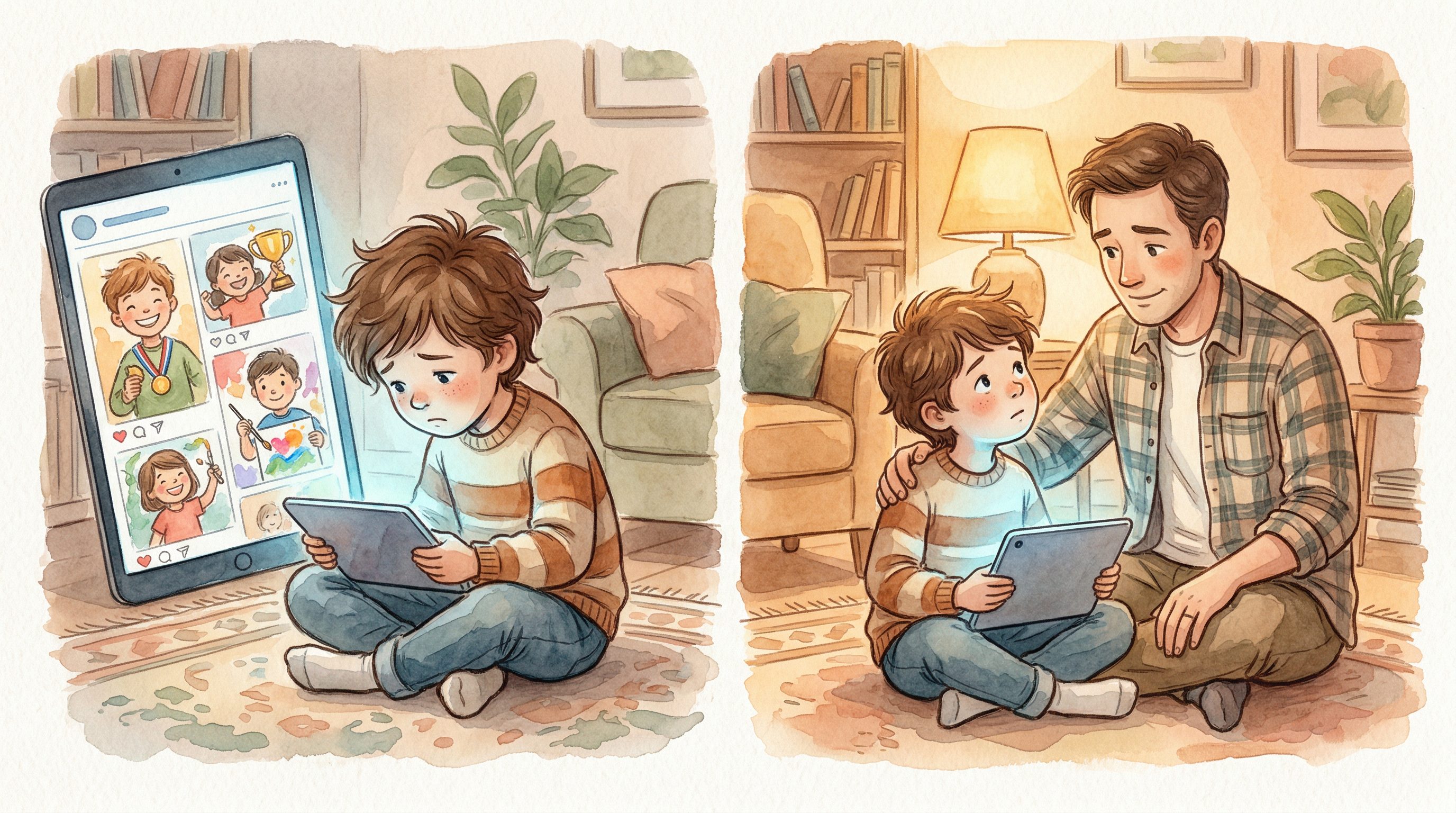
"Why Can't I Be More Like Him?"
Your kid says it out loud, or they just carry it around in their chest without telling you. Either way, you know it's there. The moment they saw someone faster, or funnier, or better at something, the comparison started. And it hasn't stopped since.
Comparison is the most normal thing in the world. It's also one of the most damaging. Not because it's evil — but because it measures your kid against a standard they were never supposed to meet: someone else's life.
You can tell them "don't compare yourself" all you want. It doesn't work. What works is giving them a better framework — a way of understanding who they are that doesn't depend on where they rank.
Why Kids Compare — and What's Really Happening
Kids compare themselves to others because they're trying to figure out where they fit. That's developmentally normal and healthy up to a point. The problem comes when "where do I fit" slides into "am I enough?" — because that question never gets resolved by comparison. There's always someone faster. Always someone who scored higher, got picked first, got more attention.
Social comparison theory — first articulated by psychologist Leon Festinger — says humans use others as a benchmark to evaluate themselves when objective measures aren't available. Your kid is doing this instinctively, every day. The goal isn't to eliminate the instinct. It's to give them a better reference point.
Faith offers that. Not as a platitude, but as a real anchor: you were made on purpose, by someone who doesn't make mistakes, to be exactly who you are. That's not an empty affirmation. That's a theological claim with teeth.
<
What the Bible Says About Your Kid's Uniqueness
Psalm 139:13-14 is the foundation here: "For you created my inmost being; you knit me together in my mother's womb. I praise you because I am fearfully and wonderfully made." Read that slowly. "Fearfully" means with great care and intentionality — not carelessly, not accidentally, not as a copy of someone else.
1 Corinthians 12 gives the body-of-Christ picture: every part is different, every part is necessary, no part is more valuable than another. An eye can't do what a hand does. A foot can't do what an ear does. Nobody wins by being more like the other part. They win by being exactly what they are, doing exactly what they were made to do.
This is the framework you want to build in your kid: you are not in competition with anyone. You are the only one who can be you, and that is not a consolation prize — it is the whole point.
Practical Conversation Starters for Bedtime
Don't make this clinical. Come in through a door they open. Here are some questions that lead somewhere real:
- "Who did you compare yourself to today? It's okay — we all do it. I still do it."
- "What does that person have that you wish you had?"
- "What do you have that they don't? What are you good at that's actually yours?"
- "What do you think God was thinking when He made you the way He made you?"
That last one will get you somewhere interesting. Kids have a surprising capacity to engage with the idea that they were made intentionally. They might not have the language for it — but they feel the weight of it.
<
The Identity Conversation Underneath the Comparison
Comparison is usually a symptom of an identity question that hasn't been answered yet. When your kid compares themselves to a classmate, what they're really asking is: Am I valuable? Am I enough? Do I matter?
The job of a faith-based dad is to answer that question before the world answers it wrong. The world will answer it with grades, athletic rankings, social popularity, and eventually income. None of those are stable enough to build a life on. You need to answer it first, and answer it often, from a foundation that doesn't move. For a devotional built around this exact foundation — helping your kid understand their identity in God — the kids' identity devotional is a great resource to read together.
The Who Made Me series is built specifically for this. It walks kids through the question of identity at a level they can actually engage with — who God made them to be, what makes them unique, why they don't have to measure up to anyone else.
Pair that with the devotional on jealousy, which takes the sibling comparison angle head-on — because sibling comparisons are often the first place this shows up in a child's life. And when the comparison is pulling your kid toward ingratitude, the devotional on gratitude is the other side of the same coin — it builds the awareness of what's already good in their own life.
What Not to Say
A few things that backfire:
- "You're better than him anyway." You're teaching them to compare up, not to stop comparing.
- "Stop being jealous." They can't just turn it off. You need to give them somewhere else to put it.
- "Everyone has struggles." True, but useless to a kid in the middle of feeling like everyone else has it easier.
What actually helps is specificity. Name what makes your kid uniquely them. Not generic praise — actual, observed detail. "You are the most naturally funny person I know. I have never met anyone who makes me laugh the way you do." That kind of specific, true affirmation lands differently than "you're great, buddy."
<
When School Makes Comparison Worse
Elementary school is a comparison machine. Grades. Reading groups. Who got picked for what. Who has the better lunch. Who ran faster in gym. It's relentless, and it's largely unavoidable. Your kid isn't going to opt out of social dynamics at school because you had a good conversation at bedtime.
But you can give them a reference point to return to. When they come home discouraged — when someone got something they wanted, when they felt behind or overlooked — you have the chance to say the same thing again, in a new context. "Remember what we talked about? You're not competing with them. What God put in you is yours. That doesn't change based on how today went." Repetition across different situations is how formation actually works. The bedtime conversation plants it; the follow-up in the hard moment waters it.
Playing the Long Game
This is a ten-year conversation, not a ten-minute one. The comparison instinct doesn't go away — it evolves. What you're building right now is a foundation your kid will lean on when the comparisons get harder: when social media enters the picture, when college admissions loom, when their peers are getting jobs and promotions and they're still figuring it out.
A kid who knows, at their core, that they are specifically and intentionally made — that kid has something to hold onto. They'll still compare. But they'll have an answer to come back to.
You're giving them that answer at bedtime. That's not small. That's exactly the right thing to do with this time.
📖 Read This Tonight
The Who Made Me series answers the identity question your kid is already asking — helping them see who they are through God's eyes before the world has a chance to define them.
Get Notified When New Series Drop
We add new devotional series regularly. Sign up to hear about them first.
Join the Community