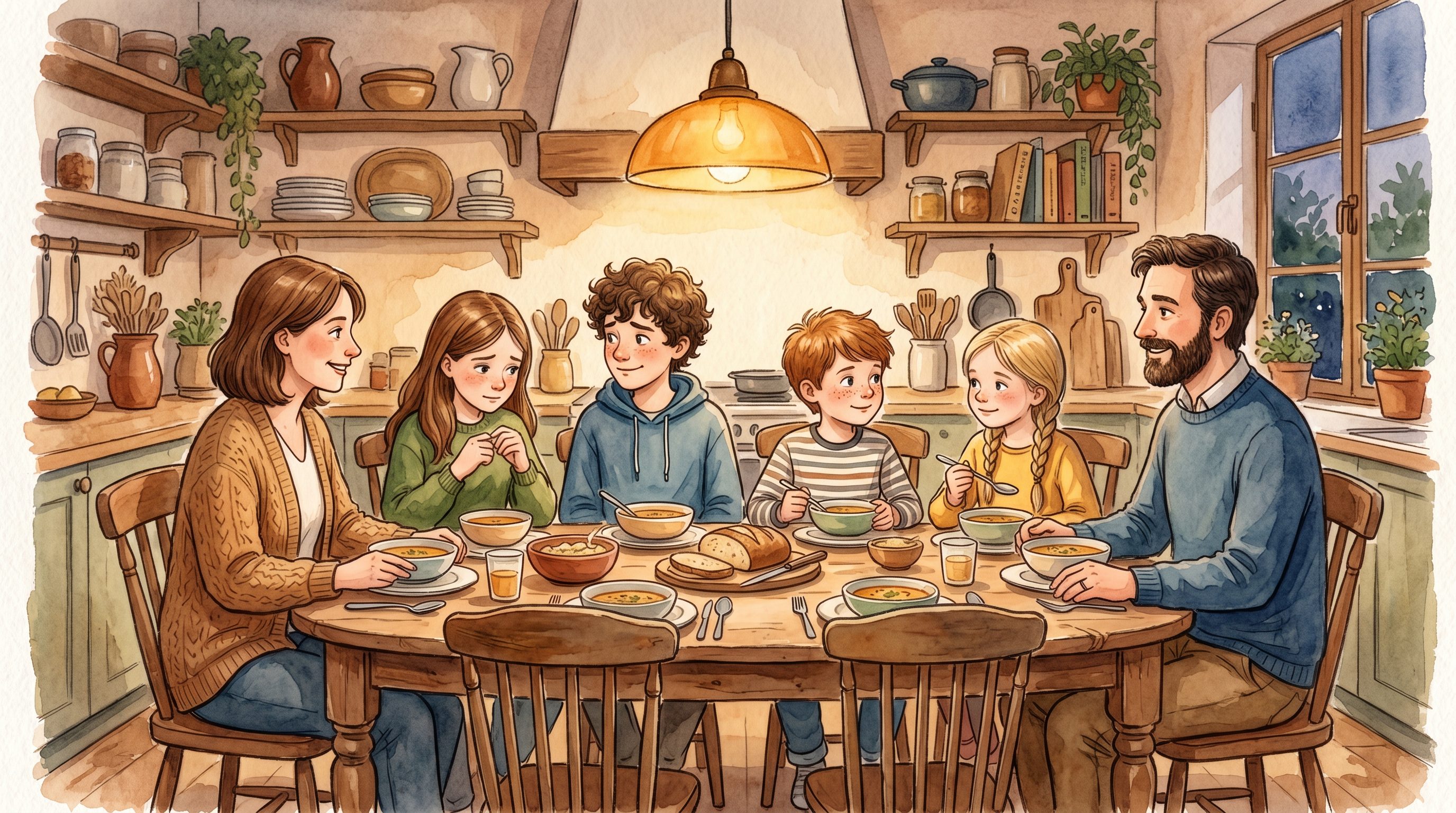
Nobody Starts Here. But a Lot of Dads End Up Here.
My family isn't blended. I'm married to my boys' mom, and our household has the kind of simplicity that I know not everyone has. So I want to be upfront: this isn't written from personal experience. It's written from what dads in blended families have told me — and from the specifics of what makes devotionals complicated, and valuable, in a blended home.
What I hear consistently: the hardest part of blending a family isn't logistics. It's the emotional complexity that no spreadsheet can solve. Kids who are still grieving the family they had. Kids who resent a new adult who's trying too hard. Stepsiblings who don't know how to be around each other. A dad who wants to lead his home spiritually but doesn't know how to do that when the family itself is still figuring out its shape.
Devotionals can be a real tool in that process — not because they fix anything, but because they create a shared practice that says: whoever we are to each other, we do this together. Over time, that matters.
What Makes Devotionals Hard in a Blended Family
In a traditional family setup, devotionals are relatively straightforward: you gather the kids, you read something, you pray, goodnight. In a blended family, every part of that is more complicated.
Who's in the room? Not every kid may be there every night — custody schedules mean some nights have some kids and other nights have others. A devotional that builds on yesterday's feels disconnected when a stepchild wasn't there for yesterday.
Who's leading? If you're the stepparent, you may not have earned the authority to lead a spiritual practice yet. If you're the biological parent with a new spouse in the home, your spouse needs a role that doesn't feel forced or fake.
How much does everyone know? Different kids may have different faith backgrounds — or no background at all. One kid grew up in church. Another didn't. Starting at the same point isn't always possible.
What about resistance? A stepchild who resents the new family situation is going to bring that resentment into devotional time if it's forced. Reading something together doesn't automatically create warmth — and if it's done badly, it can actually increase resistance.
These aren't reasons to skip devotionals. They're reasons to think about how you do them.
The Goal: Connection Before Content
Dads who've built successful devotional practices in blended families share a consistent principle: connection has to come before content. If your kids — biological or step — don't feel safe with you or with the group, no devotional content is going to land. You're talking past them.
This means the first step isn't finding the right devotional series. It's building enough relational trust that the kids actually want to be in the room with you. That might take months. And that's okay.
Dads describe a few practical things that helped build that trust before diving into formal devotionals:
- One-on-one time with each kid individually — not group devotions, just individual connection
- Low-stakes shared activities (games, cooking together, car rides) that don't have any spiritual agenda
- Asking questions and listening without trying to fix or guide anything
- Being honest about who you are without trying to be the perfect spiritual leader right away
When kids feel like they know you and trust you, they're far more open to doing something like a devotional together. Forcing it before that trust exists usually backfires.
Where to Start: Simple, Flexible, Non-Coercive
Once there's enough relational groundwork, here's what dads describe working well in blended family devotional setups:
Start with a story-based format. Stories work across faith backgrounds and resistance levels. You're not asking anyone to agree with theology — you're reading a story together and seeing what they notice. This lowers the pressure significantly. Let Me Tell You About God and Big Feelings both use this kind of accessible format.
Keep it short and optional at first. A 5-minute devotional that kids choose to be present for is worth ten times more than a 20-minute one they're forced through. Some dads describe announcing that "we're going to do a quick reading" and leaving the door open — kids who want to join, join. This approach often pulls in more participation than mandatory attendance.
Don't lead with prayer if it's unfamiliar. For a stepchild who didn't grow up in a faith household, being asked to pray out loud early is terrifying and embarrassing. Lead with reading. Then discussion. Then, once it feels comfortable, invite prayer — and keep it completely voluntary for a long time.
Acknowledge the complexity directly. You don't have to pretend this is a normal family situation. "We're doing life a little differently than some families, and that's okay. I want us to have something that belongs to all of us." Kids respond to honesty. The pretending is what alienates them.
What About the New Sibling Dynamic?
Stepsiblings are a whole category of complexity on their own. You've got kids who may have been only children, suddenly sharing space and attention with someone they didn't choose. Kids who have different rules in different households. Kids who may like each other fine but have no idea how to be siblings.
The Big Brother Devotional — which was originally built for biological siblings — has been adapted effectively by blended families for the same dynamic. The themes of patience, sharing space, navigating jealousy, learning to love someone you didn't choose — all of that applies directly to stepsibling relationships. It's worth reading together when there's sibling tension in the house.
Some topics that come up reliably and are worth addressing in devotionals:
- Fairness and jealousy — "Why does he get more time with Dad?"
- Identity — "Am I part of this family or just visiting?"
- Loyalty — "If I like my step-sibling, does that mean I'm betraying my other parent?"
- Belonging — the feeling of not quite fitting anywhere fully
None of these get solved in a single devotional. But returning to them regularly — giving them a name, bringing them to God together — matters over time.

When One Kid Is Resistant and One Isn't
This is extremely common in blended families: one kid is open to devotionals, another flatly refuses. Forcing the resistant kid backfires almost every time. Rewarding the open kid while excluding the resistant one creates resentment.
Dads who've navigated this describe a few approaches that worked:
First, let the resistant kid be present without being required to participate. They can be in the room on their phone. Over time, they often start listening. Presence without pressure eventually becomes actual engagement for some kids.
Second, address the resistance directly and privately — not during devotional time. "I know this feels awkward. I'm not trying to force you into anything. I just want us to have something that belongs to all of us. What would make it feel less weird for you?" Asking that question and actually listening to the answer is often the turning point.
Third, find the version of this that fits the resistant kid specifically. If they respond to music, use worship music as the entry point. If they respond to questions, make it more Socratic. If they're an older teenager, maybe it's a one-on-one conversation rather than a group setting.
For more on the specific dynamics of welcoming a step-parent into the family from the kids' perspective, this companion article covers what actually helps kids through that transition.
The Long Game
Every dad I've talked to who has built something real in a blended family says the same thing: it took longer than I expected, and it was worth it. The first six months felt like forcing puzzle pieces that didn't fit. The second year felt like something was actually starting to form. By year three, there was something — not perfect, not the same as a family that had always been together, but real.
Devotionals in a blended family aren't about making everything feel normal faster. They're about laying down one small brick at a time, night after night, toward something that eventually becomes home. That's the goal. Keep building.
Creating Something That Belongs to the New Family
One of the most powerful things you can do in a blended family is create something that belongs specifically to the new family — not the old one, not each household separately, but this family. A devotional practice that nobody had before, that you built together, becomes part of the family's identity in a way that's hard to achieve any other way.
Dads describe doing this in a few ways. Some let the kids help choose the first series they read together — giving them agency in the start of something new. Some create a specific ritual around it: a certain candle, a specific spot in the house, a snack they only have during devotional time. These small, consistent details tell the kids: this is ours, this is real, this belongs to all of us.
Some families even build a custom series together — something that addresses their specific family situation in their specific language. You can do that here, and for a blended family, a series that directly addresses what your kids are navigating — the new siblings, the changing household, the feelings they're sorting through — can be more effective than a general devotional not designed for their situation.
The goal isn't to create a perfect devotional experience. It's to create a real one — one that belongs to the family you're actually in, with the kids you actually have, in the season you're actually navigating. That's what lasts. That's what the kids will remember. Not a performance of family devotions, but the actual thing — imperfect, honest, and done together.
📖 Read This Tonight
When Things Change is a short devotional series for families navigating transition and new dynamics. Start here — it's designed to be accessible for kids in any family situation.
Get Notified When New Series Drop
We add new devotional series regularly. Sign up to hear about them first.
Join the Community