Your Kid Doesn't Have to Love Reading for This to Work
Let's get this out of the way: devotionals don't require your child to be a reader. They require you to be one. You read it. They listen. That's the whole format. And for a lot of kids — especially boys — listening to a trusted person tell them a story is actually more engaging than being handed a book and told to sit still.
The problem isn't usually the child. It's the devotional format. Most kids' devotionals are written assuming the child will read them independently — which means the language is formal, the layout is text-heavy, and the application points are abstract. That doesn't work for any kid at bedtime, let alone one who already resists reading.
If devotions have been a fight in your house, there's a good chance it's not your kid's faith or even their attention span. It's the format.

What a Non-Reader Actually Needs
A kid who doesn't like reading is often a kid who:
- Learns better by hearing or doing than by reading
- Gets frustrated when they can't follow the text as fast as others
- Loses interest when content is dense, abstract, or slow to get to the point
- Responds much better to conversation than to recitation
None of those are problems with faith. They're just learning styles. And devotionals can absolutely be adapted to them — without compromising the content.
The key adjustments: shorter readings, stronger stories, and more conversation than lecture. You're looking for content that tells a story with momentum, gets to the point quickly, and ends with a question that actually makes your kid think rather than an application point that makes them feel like they just got homework.
What Doesn't Work (And Why)
Long passages of text. Even a motivated reader starts losing attention after 3-4 paragraphs at bedtime. For a resistant reader, it's much sooner. Keep the reading under two minutes if you can.
Abstract theology. "God is omniscient" means nothing to a 7-year-old who doesn't like reading. "God knows you so well he knows what you're going to say before you say it" — that's a concept. Lead with concrete, specific ideas.
Independent reading expectations. If your format requires the child to read, you've immediately excluded kids who find reading laborious. Read it yourself, in your voice, with appropriate energy. You're not doing the devotional at them — you're doing it with them.
Application points that feel like homework. "This week, practice saying kind words to three people" is an assignment. "What's one thing you could do differently tomorrow?" is a conversation. One closes the interaction; the other opens it.

Formats That Actually Work
Story-led devotionals. If the devotional leads with a story rather than a scripture passage or a theological concept, you're already ahead. Stories create momentum. Even a resistant reader will stay engaged in a good story — because they want to know what happens next. Look for devotionals that tell the Bible story in an engaging, present-tense way rather than summarizing it.
Short-form content. Five minutes is enough. Seriously. A tight, well-told story followed by one honest question and a short prayer is more valuable than thirty minutes of a kid checking out. Consistent short sessions build far more habit and faith than occasional long ones.
Conversational prompts instead of lessons. After the story, instead of explaining what it means, ask what your kid thinks it means. Let them talk. You'll be surprised. Kids who resist reading often have vivid imaginations and strong opinions — they just need a format that lets those out instead of suppressing them.
Interactive elements. A question your kid can actually answer, a moment where they guess what happens next, a spot where they weigh in on a character's choice — these break the passive listening into active engagement. For kids who learn by doing, even small interactive moments keep them present.
If the broader challenge in your house is that your kid resists devotionals altogether — not just the reading part — this guide to what to do when your kid doesn't want to do devotions covers the resistance side specifically. And for making the overall experience more engaging regardless of reading ability, this piece on making family devotions fun has practical approaches worth trying.
Reading Aloud Is Enough
Here's something worth saying directly: reading aloud to your kid is not a crutch or a workaround. It's actually one of the most effective ways to build comprehension, vocabulary, and engagement — even with older kids who technically can read independently.
Your voice carries tone, emphasis, and emotion that text on a page doesn't. When you read a devotional with expression — slowing down at the tense part, pausing to let something land — you're doing something no children's Bible app does. You're making the story feel alive.
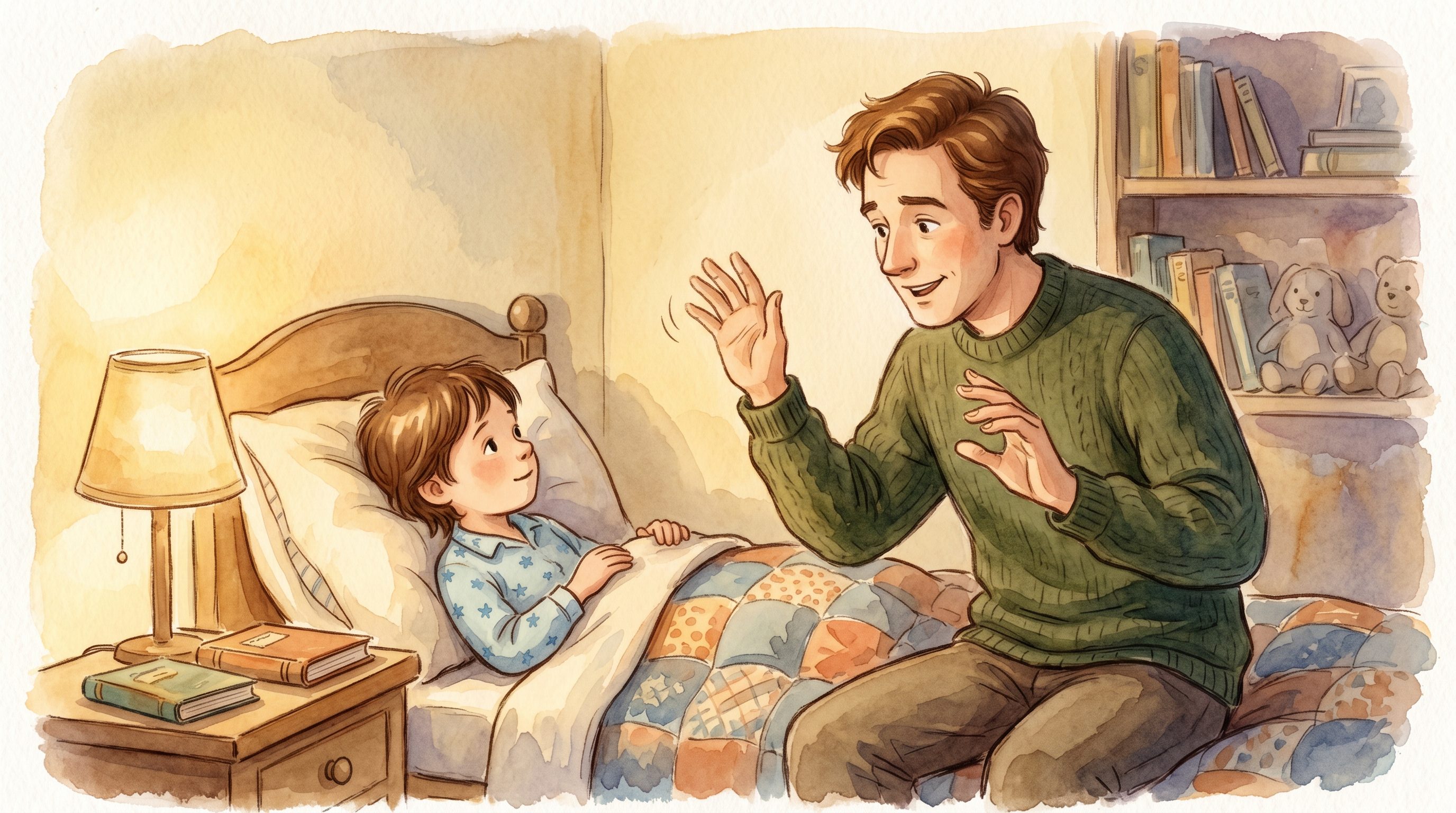
I built Hosted Devotions with this in mind: the content is designed to be read aloud by a dad, in your kid's room, at the end of the day. The language is conversational, the stories move, and the questions are designed for a real conversation — not a quiz. Your kid doesn't need to be a reader. You do.

A Note on Kids With Reading Challenges
If your kid's resistance to reading goes beyond preference — if they're working with dyslexia, processing differences, or other learning challenges — devotional time can actually be a relief rather than a pressure point. It's one time in the day when reading skill is irrelevant. The table is completely level.
That's worth something. For a kid who spends a lot of their school day behind, bedtime devotionals with dad can be a space where they're not behind at all — where the conversation is just between the two of you, and what they think matters more than how fast they read.
Browse the full Hosted Devotions library and find something that fits your kid's interests — not their reading level. That's the right starting point.
The Listening Kid: A Different Kind of Engagement
Here's something most parents of non-readers discover once they stop fighting the format: kids who resist reading often turn out to be exceptional listeners. They notice details. They remember what you said last week. They pick up on tone and emphasis in ways readers sometimes miss because they're too focused on processing the text.
When you read aloud to your kid — really read, with expression and presence — you're giving that kind of kid exactly what they're wired for. They're not passive. They're processing in their strongest mode.
This is worth reframing in your own mind. You're not compensating for a weakness. You're playing to a strength. And a kid who walks into adolescence knowing that someone valued their mind — that they were a person worth talking to, not just at — carries that with them.
Some of the best conversations I've had during devotionals happened when I put the book down and just told the story in my own words. That's always an option. If the reading is breaking the flow, set it aside and talk. The content matters less than the connection.
📖 Read This Tonight
Browse devotional series built for bedtime — short, story-driven, and designed to be read aloud by dad. Find something that fits your kid's world, not their reading level.
Get Notified When New Series Drop
We add new devotional series regularly. Sign up to hear about them first.
Join the Community