The Right Story at the Right Age
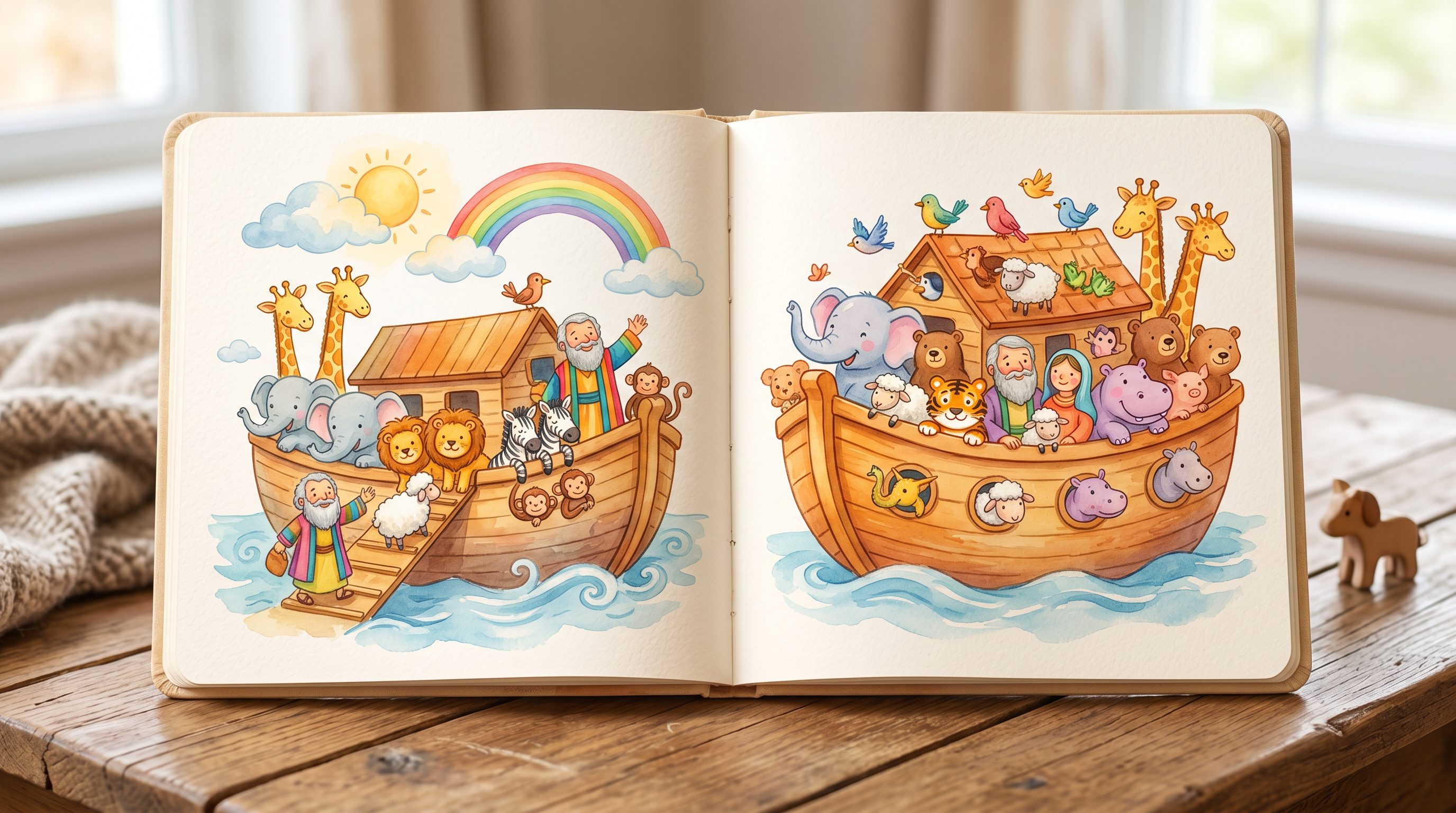
There's a version of the Noah's Ark story designed for preschoolers — bright animals, a happy boat, a rainbow at the end. And then there's the full version, which is actually a story about God being grieved by sin and wiping out almost all of humanity.
Both are in the same Bible. Only one is right for your three-year-old.
This is the part of faith parenting that doesn't get talked about enough: not all Bible stories are appropriate for all ages, and knowing which ones to read when makes a difference. Not because you're hiding the truth from your kids — you're not. But because a preschooler's brain is developmentally wired for certain things, and not others. Giving them the wrong story at the wrong age doesn't build faith. It confuses, or worse, frightens.
Here's what actually works for preschoolers.
What Preschoolers Can Actually Handle
Before picking stories, it helps to know what's going on in a preschooler's brain. Kids ages 2-5 are concrete thinkers. They process the world through their senses and through relationship. They understand: love, safety, belonging, cause and effect at a simple level, fairness in basic terms.
They do not yet process: abstract moral reasoning, large-scale tragedy, complex villains and victims, metaphor at a literary level, death and loss without reassurance built in.
That doesn't mean preschoolers can't handle any conflict in a story. They can — but it needs to resolve in a way that feels safe. The tension should be followed by comfort. The danger should be followed by rescue. That arc maps directly onto what they're able to emotionally absorb.
Best Bible Stories for Preschoolers
Creation (Genesis 1–2)
This is the best starting point for any preschooler. God made the world. He made animals and plants and water and sky. He made people. He said it was good. There's no conflict, no villain — just wonder and belonging. Preschoolers love animals and they love the idea that everything was made on purpose. Let them name the animals. Ask them which day they would have liked best. This one hits.
Baby Moses in the Basket (Exodus 2:1-10)
This story has all the elements preschoolers respond to: a baby, a basket, a river, and a happy ending. A mama who loves her son puts him somewhere safe because she has to. A princess finds him and takes care of him. You can tell this story without going anywhere near Pharaoh's decree. Just: a baby was in danger, his family kept him safe, and God watched over him. That's enough.
David and the Giant (1 Samuel 17, simplified)
Keep it simple: there was a really big man who was very scary, and a young boy who wasn't scared because he trusted God. The boy won. Preschoolers love this one because they identify with being small. The message — God helps you even when you're little — is one of the most formative things a preschooler can take in.
Jesus and the Children (Mark 10:13-16)
The disciples tried to keep children away from Jesus. Jesus said no — let them come. He held them and blessed them. For a preschooler, this story says something profound: Jesus wanted me there. He didn't push me away. Read it slowly. Let them feel it.
Jonah and the Fish (Jonah 1-3, simplified)
A man ran away. He ended up in a fish. He called out to God. God gave him a second chance. Preschoolers love the fish part (obviously), and the idea of God giving second chances is one they need to hear early and often. Don't get into Jonah's anger at the end — that's for older kids. Just tell the rescue story.
The Lost Sheep (Luke 15:3-7)
A shepherd has 100 sheep. One goes missing. He leaves the others to find the lost one. When he finds it, he's so happy he tells everyone. Jesus is the shepherd. You are the sheep he goes looking for. Preschoolers get this story in their gut. They've felt lost. They've been found. The emotional resonance is immediate.
Stories to Save for Later
Some stories are in the Bible but aren't right for preschoolers — not because they're not true, but because they require developmental tools your three-year-old doesn't have yet.
The crucifixion is one. Not because it shouldn't be told — it absolutely should be, and it will be — but because the weight of it requires a certain emotional and cognitive maturity to process rightly. A preschooler will mostly be confused and potentially frightened. Wait until around age 6-7 to go there, and even then, pair it with the resurrection first so they have the full arc.
Job is another. Loss and suffering at that scale, without resolution that feels safe, can actually frighten preschoolers rather than build faith. Save it.
The plagues of Egypt — same thing. Preschoolers don't need the full weight of that story yet. The parting of the Red Sea? Yes. Moses leading the people? Yes. The plagues and the death of the firstborn? That can wait.
How to Tell Bible Stories Well at This Age
The story matters, but so does how you tell it. A few things that work well with preschoolers:
Use voices and sound effects. Whooosh — that's the wind at creation. Drip drip drip — the rain on Noah's ark. Stomp stomp stomp — the giant walking. They are all in. Preschoolers love physical sound. Use it.
Pause and ask questions as you go. "Do you think David was scared? Would you be scared?" That keeps them engaged and helps them put themselves in the story. It's not an interruption — it's the whole point.
Connect the story to their life. "God watched over baby Moses, just like he watches over you." "Jesus wanted the children to come to him — that means you too." The application doesn't have to be long or complicated. One sentence at the end is enough.
Don't rush the wonder. Let them sit with a moment. They might ask to hear the same story five nights in a row. That's not boredom — that's processing. Let them. Something is landing.
For more ideas on what to read with young kids, the post on teaching kids generosity through Bible stories gives another angle on making Scripture stick at this age. And when you're ready to build a consistent rhythm around it, check out the piece on how to use devotionals to address big emotions your kid is feeling — because often, the best time to read a Bible story is when something in your kid's life makes it real.
Building a Habit Around Bible Stories
The most effective thing isn't which story you pick — it's whether you come back tomorrow. Preschoolers learn by repetition. They need to hear the same truths from the same stories from the same person over and over. That's not a failure of variety. That's how faith gets laid down.
Pick a time (bedtime works for most families because the house is quieter and kids are naturally winding down). Pick a story. Read it. Ask one question. Pray together. Done. Five minutes. That's enough.
If you want a structured series to guide those bedtime conversations, the Who Made Me series was built for this exact age — questions about God and creation in language a preschooler can hold. It takes all the "what do I say?" out of the equation.
Start simple. Start tonight. The stories you read to your preschooler now are going to be in them for life.
📖 Read This Tonight
The "Who Made Me" series is built for preschoolers — short, wonder-filled conversations about God and creation that your 2-5 year old will ask to hear again and again.
Get Notified When New Series Drop
We add new devotional series regularly. Sign up to hear about them first.
Join the Community