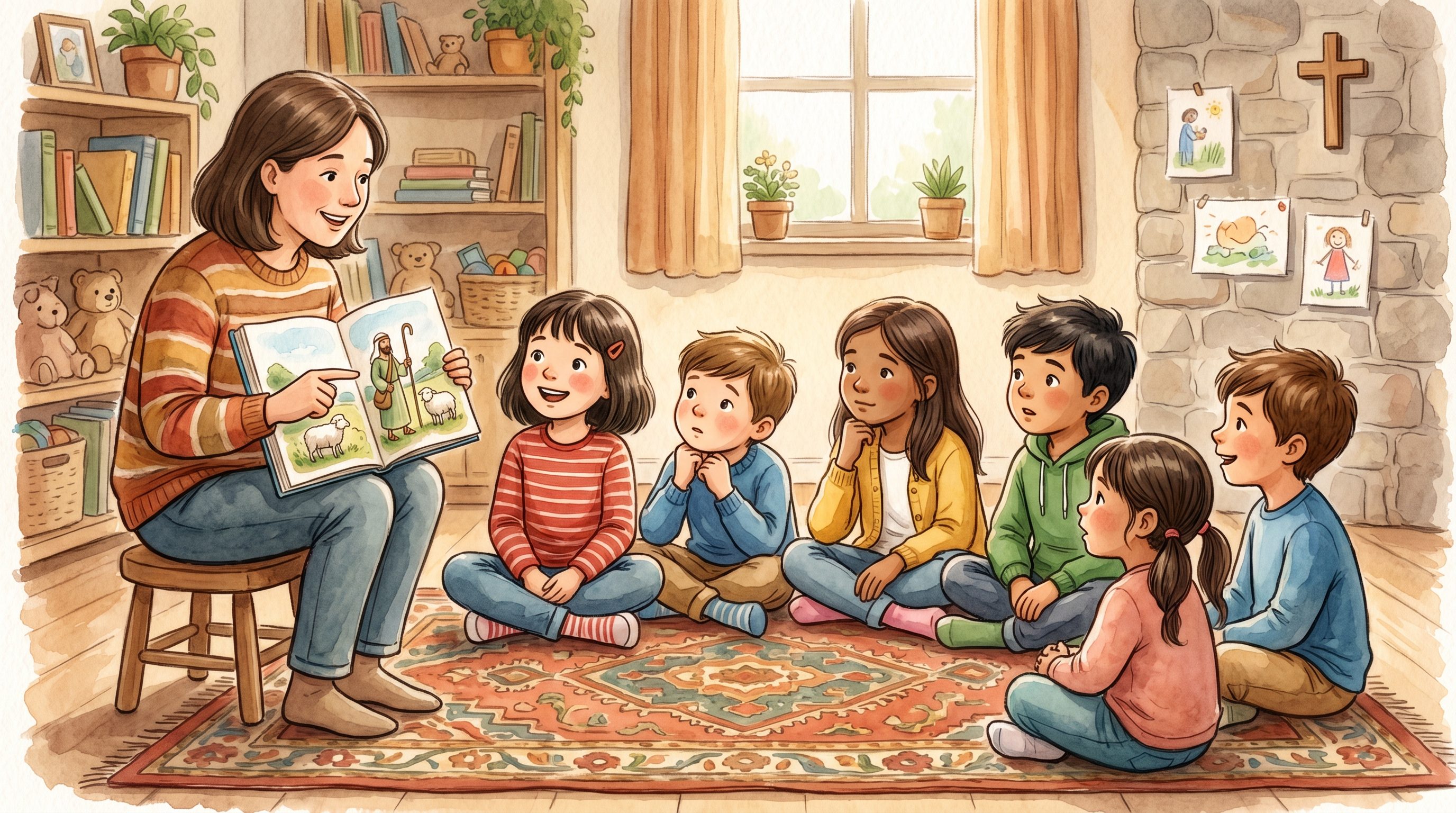
Five-to-Seven Is a Different League
Something shifts around kindergarten. Your kid's questions get sharper. Their ability to track a story deepens. They start caring about why — why did that character do that, why did God let that happen, what was the point.
If you've been reading Bible stories at the preschool level — simple, visual, mostly about animals and boats and happy endings — you've built the foundation. But ages 5-7 are ready for more. More moral complexity. More character depth. More story structure they can actually follow.
The question isn't whether to level up. It's which stories to use, and how to tell them in a way that lands at this age.
What Kids Ages 5-7 Are Ready For
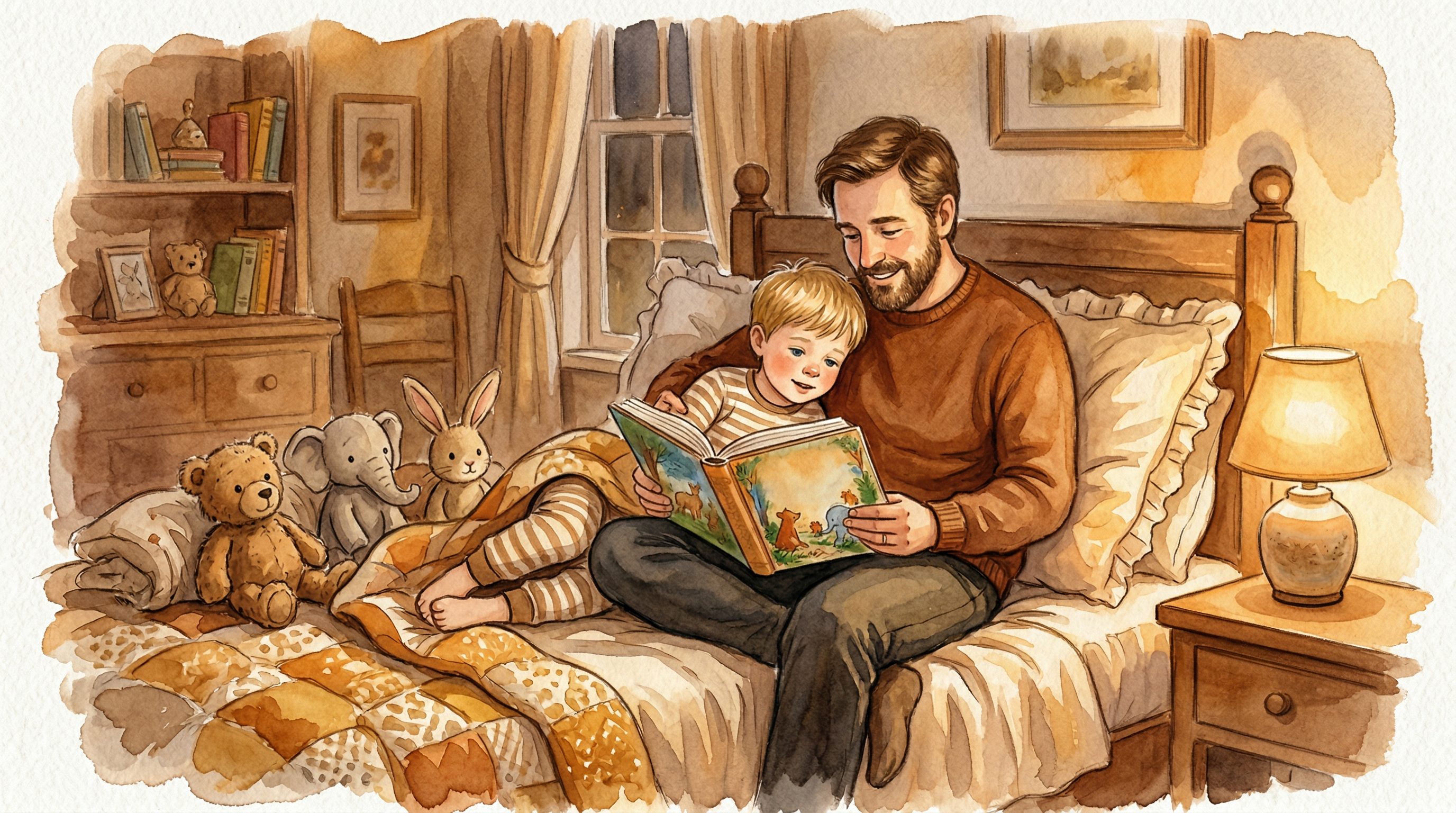
Between kindergarten and second grade, something significant happens cognitively. Kids can track a multi-part narrative. They can hold tension — a character in a hard situation without the resolution coming immediately. They understand cause and effect at a more sophisticated level. They're starting to develop real moral reasoning: Was that the right thing to do? What should he have done instead?
They can also begin to understand that real heroes have flaws. That good people make mistakes. That faith doesn't mean everything works out perfectly — it means you keep going anyway.
These are the building blocks of a real, durable faith. And 5-7 is exactly the window to start laying them.
The Best Bible Stories for Ages 5-7
Joseph and His Brothers (Genesis 37-45, in pieces)
This is one of the richest stories in the Bible for this age. A boy who was his father's favorite. Brothers who were jealous and did something terrible. Years of hardship. And then — an outcome that only God could have arranged. Joseph forgives his brothers. "You meant it for evil, but God meant it for good."
At 5-7, kids can follow this story across multiple nights. They'll feel the injustice of what the brothers did. They'll be genuinely surprised by the ending. And the takeaway — that God can work through hard things — is one of the most important truths in all of Scripture.
Don't try to tell the whole thing in one sitting. Split it: Joseph's dreams and the pit (night one). Egypt and Potiphar (night two). Prison and the Pharaoh's dream (night three). The reunion (night four). Take your time.
Daniel in the Lion's Den (Daniel 6)
A man who prayed even when it was against the law. He got thrown into a pit with lions. God shut the lions' mouths. Daniel walked out alive.
Five-to-seven-year-olds love the drama of this one. They understand peer pressure — they're starting to experience it themselves. The message that you do what's right even when it costs you something is one that lands hard at this age, in the best way.
Esther (Esther 1-9, simplified)
A girl who became a queen and ended up having to make the bravest decision of her life. "For such a time as this." Kids this age — especially girls, but boys too — respond to a hero who didn't feel brave but acted anyway. Esther was scared. She did it anyway. That's the story.
The Paralyzed Man and His Friends (Mark 2:1-12)
Four friends carry a paralyzed man to Jesus. The house is too crowded to get in. So they cut a hole in the roof and lower him down. Jesus heals him. This story has everything: friendship, creativity, persistence, and a miracle that comes from people who refused to give up on their friend. Ask your kid: would you do that for your friend?
Zacchaeus (Luke 19:1-10)
A short man who cheated people out of money climbed a tree to see Jesus. Jesus saw him and invited himself over for dinner. Zacchaeus was so changed by that encounter that he gave back everything he'd taken, and then some. For 5-7 year olds: the person everyone rejected was the one Jesus went to. The lesson isn't about being short. It's about who Jesus actually moves toward.
The Feeding of the Five Thousand (John 6:1-14)
A massive crowd, no food, and a boy who offers what little he has. Five loaves and two fish. Jesus blesses it and it feeds thousands, with leftovers. For kids who are starting to understand scarcity — who's getting more, who has less — this one hits differently. What you give to Jesus, he multiplies. That principle is worth planting early.

How to Tell These Stories for Maximum Impact
At 5-7, you can start asking deeper questions after the story. Not just "what happened?" but "why do you think he did that?" and "what would you have done?" These questions turn a bedtime story into an actual conversation.
A few techniques that work well:
Read the story first, then ask one question. Don't pepper them with questions — pick one and let it breathe. "What do you think Joseph felt when he saw his brothers again?" gives you a whole conversation. Five questions feel like homework.
Connect the story to something in their life this week. "You know how you felt left out at lunch yesterday? I think Daniel knew that feeling. He kept going anyway. So did you." That connection between the ancient story and their Tuesday is where faith becomes real.
Let them ask questions back. "But why didn't God just stop the brothers from throwing Joseph in the pit?" is a legitimate question. Don't brush it off. "I don't know. But somehow God used all of that to get Joseph to where he needed to be. That's kind of wild, right?" Honest wonder is better than a neat answer.
Connecting the Dots Between Age Groups
If you've been reading stories at the preschool level, you've already built something. The stories you read to them at three and four — the gentle ones, the wonder-filled ones — created a sense of who God is. Now you're building on that.
The guide to Bible stories for preschoolers covers what works at that stage if you want to see the full arc. And for the foundational stories that serve as a bridge from toddler to early elementary, the piece on age-appropriate Bible stories for babies and toddlers is worth a read.
The progression matters. You're not just reading stories — you're building a library in your kid's mind and heart that they'll draw from for the rest of their life.

A Note on the Hard Stories
Around 6-7, you can start gently introducing harder themes. Not the full weight of them — but the first layer. The crucifixion is a good example. At 5-6, tell it simply: Jesus died. It was very sad. But then something that had never happened before happened — he came back to life. That's enough. The theological depth can come later. The emotional truth — this is the most important thing that ever happened — starts here.
Same with stories like Job, or the conquest narratives. You don't need to expose them to everything at once. But you can start pulling back the curtain, a little at a time, as they're ready.
If you want a ready-made series to guide these conversations without having to build them from scratch, the Let Me Tell You About God series picks up where preschool wonder leaves off — it's built for kids who are starting to ask the harder questions, with a dad leading the conversation.
The stories you choose for ages 5-7 will shape how your kid thinks about God, about hard situations, about what faith actually means in real life. Take it seriously. And keep showing up.
📖 Read This Tonight
The "Let Me Tell You About God" series is built for kids who are ready to go deeper — big questions about God and faith, led by a dad, in language a 5-7 year old can actually engage with.
Get Notified When New Series Drop
We add new devotional series regularly. Sign up to hear about them first.
Join the Community