
Stop Waiting for the Right Time to Start
There are dads who have been "about to start" family devotions for three years. They have the book. They have the good intentions. They have a vague plan that starts on Monday, or after the holidays, or when things calm down at work. And the Monday keeps moving.
I'm not judging it — I had my own version of this. But I want to say something directly: there is no version of your life coming where it will be easier to start than tonight. Things won't calm down. The schedule won't open up. Your kids won't be younger and more receptive than they are right now. The right time is not coming. Tonight is the right time.
So here's exactly what to do. Not a motivation speech. A plan.
Why Most Devotional Habits Die
Before the plan, it's worth understanding the failure mode. Because most dads who try to start a devotional habit do fail — not because they don't care, but because they set the habit up wrong from the beginning.
Here's the pattern: They start strong. Night one is good. Night two is good. Night three they're tired and skip it. Night four they mean to do it but something comes up. A week goes by. The whole thing becomes a thing they were doing and then stopped. Restart energy is much harder than start energy, so they don't restart, and eventually the book or the app becomes something they feel vaguely guilty about when they see it.
That pattern is predictable and preventable. It has almost nothing to do with motivation or commitment. It has everything to do with structure. Here's how to build the structure that prevents it.
Tonight: The First Night
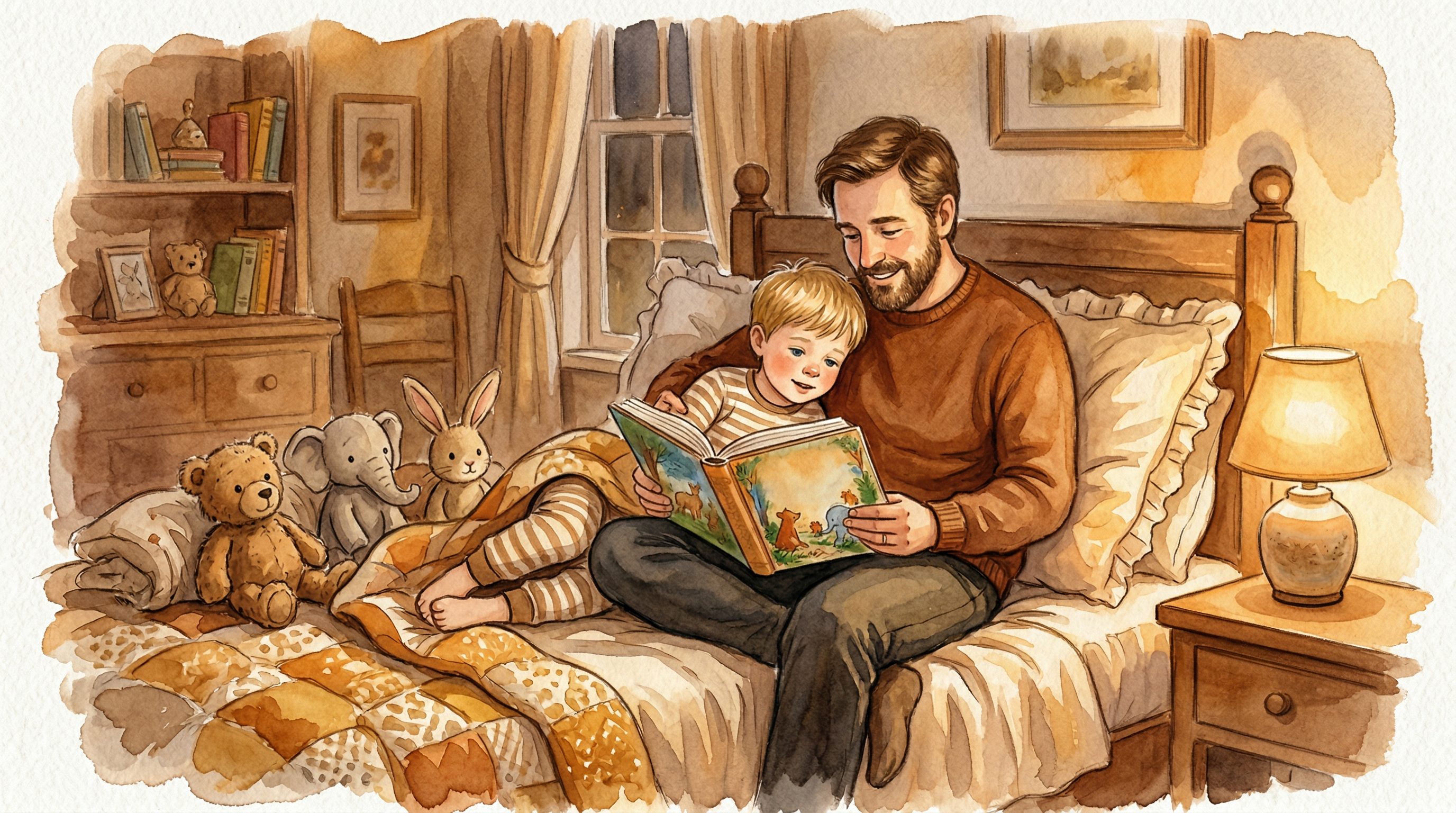
Do not prepare extensively for the first night. Preparation is a trap — it lets you feel productive while delaying the actual thing. Here's what tonight looks like:
Step 1: Pick a series right now
Go to the library and spend three minutes picking a series. Match it to your kid's age and whatever's most relevant to their life right now. If you're not sure, pick Let Me Tell You About God — it's a clean starting point for kids of almost any age who haven't done devotions before. Don't overthink this. You can always do a different series next.
Step 2: Do it in the existing bedtime window
Don't add devotions on top of bedtime. Fold them into it. After the teeth-brushing and the getting-into-bed routine, before you turn the lights off or turn on the sound machine — that's the window. You're already there. You're already doing the tuck-in. This is not a new thing you're adding to your evening. It's a new thing you're doing inside something that already happens.
Step 3: Read it out loud
Open the first entry. Read it out loud to your kid. Don't perform it. Don't explain it before you read it. Don't add commentary in the middle. Just read it, the way you'd read any story — in your regular voice, at a normal pace. You're not a preacher. You're a dad reading something to your kid.
Step 4: Ask the question
Every entry ends with a question. Ask it. Then stop talking and actually listen. Resist the urge to answer it yourself or to guide them toward the "right" answer. Whatever they say is the right answer for tonight. The conversation that comes out of honest listening is the point.
Step 5: Pray, or don't
If prayer feels natural, do it. Simple and short. If it doesn't feel natural yet, skip it. You can add it later. Don't let the discomfort of something unfamiliar stop you from starting something important. The devotional itself is enough to begin with.
That's night one. Five minutes, maybe seven. It wasn't that hard.

The First Week: Building the Pattern
The first night proves to yourself that you can do it. The first week proves that it wasn't a one-time thing. Here's how to make the first week stick:
Do it again tomorrow night
This sounds obvious. It isn't. The night after a successful first night is when most habits quietly die — because you did the thing, you feel good about it, and then life moves on and it doesn't happen again for a week. The second night is more important than the first. Do it again tomorrow.
Set a minimum, not a goal
Don't aim for seven nights a week right out of the gate. Aim for four. If you hit six, great. If you hit four, you're building a habit. Perfectionism kills consistency — the moment you miss a night and feel like you've failed, the whole thing is at risk. A minimum gives you room to be human without feeling like you've broken something.
Tell your kid what you're doing
At some point in the first week — not in a big speech, just naturally — say something like: "I want us to do this together most nights. It's important to me." That's it. You've just created shared ownership. Your kid will start to expect it. That expectation is your accountability system.
Handle missed nights like a pro
You will miss a night this week. Probably two. That's not failure — that's normal. The only rule is: don't let two missed nights become a week. The next night after a miss, just do it again. Don't acknowledge the break. Don't reset. Just continue from where you left off in the series. The goal is consistency over time, not a perfect streak.
The article on keeping devotions consistent goes deeper on this — specifically the guilt loop that kills most habits and how to sidestep it.
After the First Series: What Comes Next
You'll finish your first series in two or three weeks depending on how often you do it. When you get to the last entry, something usually happens: your kid asks "are we done?" or "can we do another one?" That's the signal that the habit is real.
When you finish, pick the next series immediately — don't let there be a gap. The gap is where habits go to die. Have a conversation with your kid about what they want to read next. Give them two or three options. The choice gives them investment in the next series before it starts.
If you want a tighter structure for the actual bedtime window — how long to spend, what order to do things in, how to handle nights when everyone's tired — the 5-minute bedtime devotional routine is exactly that.
What to Do When You're Not Feeling It
This is going to happen. Some nights you're going to walk into your kid's room and you're not in the right headspace for a devotional. You're distracted, you're tired, something at work is sitting on you. You don't feel present. You don't feel spiritual. You feel like a man running on fumes trying to do one more thing before you can finally stop.
Do it anyway. Short version if you need to. Read the entry, ask the question, done in four minutes. Your kid doesn't need you to bring your A-game every single night. They need you to show up. There's a version of every devotional that takes four minutes and still counts. Done imperfectly is infinitely better than not done.
If you want practical ways to handle the nights when you're running low — whether that means shortening the devotional, letting your kid lead it, or building in some grace for yourself — the guide on keeping devotions consistent covers all of it. The short version: the goal is the pattern, not the performance.
The Role of the Mission
One thing that keeps kids engaged in devotionals beyond the first week is the mission component. Each series entry ends not just with a question but with a specific action — a thing your kid is supposed to do the following day. Small, concrete, meaningful. It might be something like: be kind to someone who's having a hard day, or say something encouraging to your sibling, or ask someone how they're doing and really listen.
The mission turns the devotional from a thing you read to a thing you live. And it gives you a built-in conversation starter the next night: "Hey, did you get a chance to do your mission today?" Your kid will remember it. They'll have a story about it. That follow-through moment — brief as it is — is often where the real learning happens.
It also keeps the habit alive between nights. The devotional isn't just a bedtime thing. It's something your kid is carrying into their day. That continuity is part of what makes the habit feel like it matters, which is what makes it stick.

The One Thing That Makes or Breaks a Habit
I've talked to a lot of dads about this. The ones who build a devotional habit that actually lasts — that goes for months, then years — all have one thing in common: they attached it to something that was already happening.
Bedtime is that anchor. You're already there. The routine already exists. Devotions become part of the routine rather than a separate thing requiring its own activation energy. That's the structural key.
Everything else — the right series, the right length, the right questions — is secondary to that. Find your anchor. Build around it. Start tonight.
And if you want to make sure you're picking the right first series for your specific kid, this guide to choosing the right devotional walks through the whole library by age and situation.
📖 Read This Tonight
If the habit is the goal, the 5-minute routine is the system that makes it repeatable. Here's exactly how to structure every bedtime so devotions fit in without adding stress.
Get Notified When New Series Drop
We add new devotional series regularly. Sign up to hear about them first.
Join the Community