Two Minutes. That's Your Window.
If your kid is 3, you already know this. You sit down to read something, you get four sentences in, and they're pointing at a bug on the wall, asking for water, or suddenly very interested in what the dog is doing. Three-year-olds are not designed to sit still and absorb spiritual content. That's not a problem to fix — it's just their age.
The mistake most parents make is trying to find a "devotional" for a 3-year-old that works like a devotional for a 7-year-old. They search for something with multiple paragraphs, a Bible verse to memorize, and a reflection question. Then they wonder why their toddler has fully left the building after 45 seconds. The book wasn't the problem. The format was.
Here's what actually works at this age — and it's simpler than you think.
What a 3-Year-Old Can Actually Do
Before you pick any devotional, it helps to know what you're working with developmentally. At 3, kids are operating in very short bursts. Their attention span for a structured activity is roughly 2 to 5 minutes, and that's on a good night, when they're not overtired and nobody has eaten something wrong at dinner.
But here's what a 3-year-old is surprisingly good at:
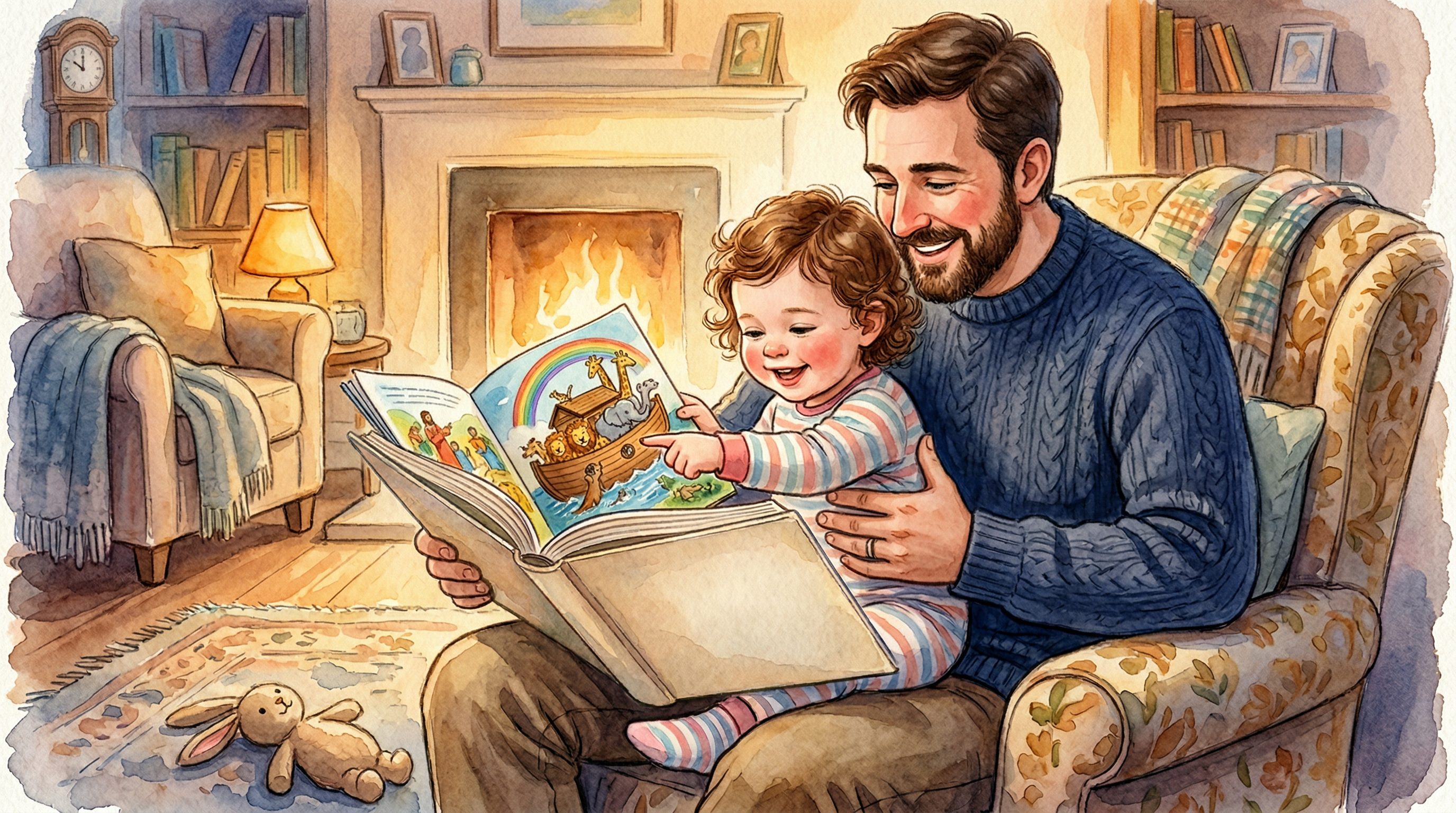
- Pointing and naming. Show them a picture, they'll tell you what they see. That's engagement.
- Repeating simple phrases. "God made me." "I am loved." Say it once, say it twice, they'll say it back.
- Asking one-word questions. "Why?" is their whole personality at this age, and you can work with that.
- Physical participation. Touch the picture, point to their nose, clap once — movement keeps them present.
The best devotional for a 3-year-old leans into all of these instead of fighting against them. It's picture-heavy, it has a simple one-sentence truth, and it ends before they're ready to be done — which means they'll actually want to do it again tomorrow.
The Point-and-Talk Format
This is the approach that actually holds a 3-year-old's attention, and you can apply it to almost anything you're reading with them. Here's how it works:
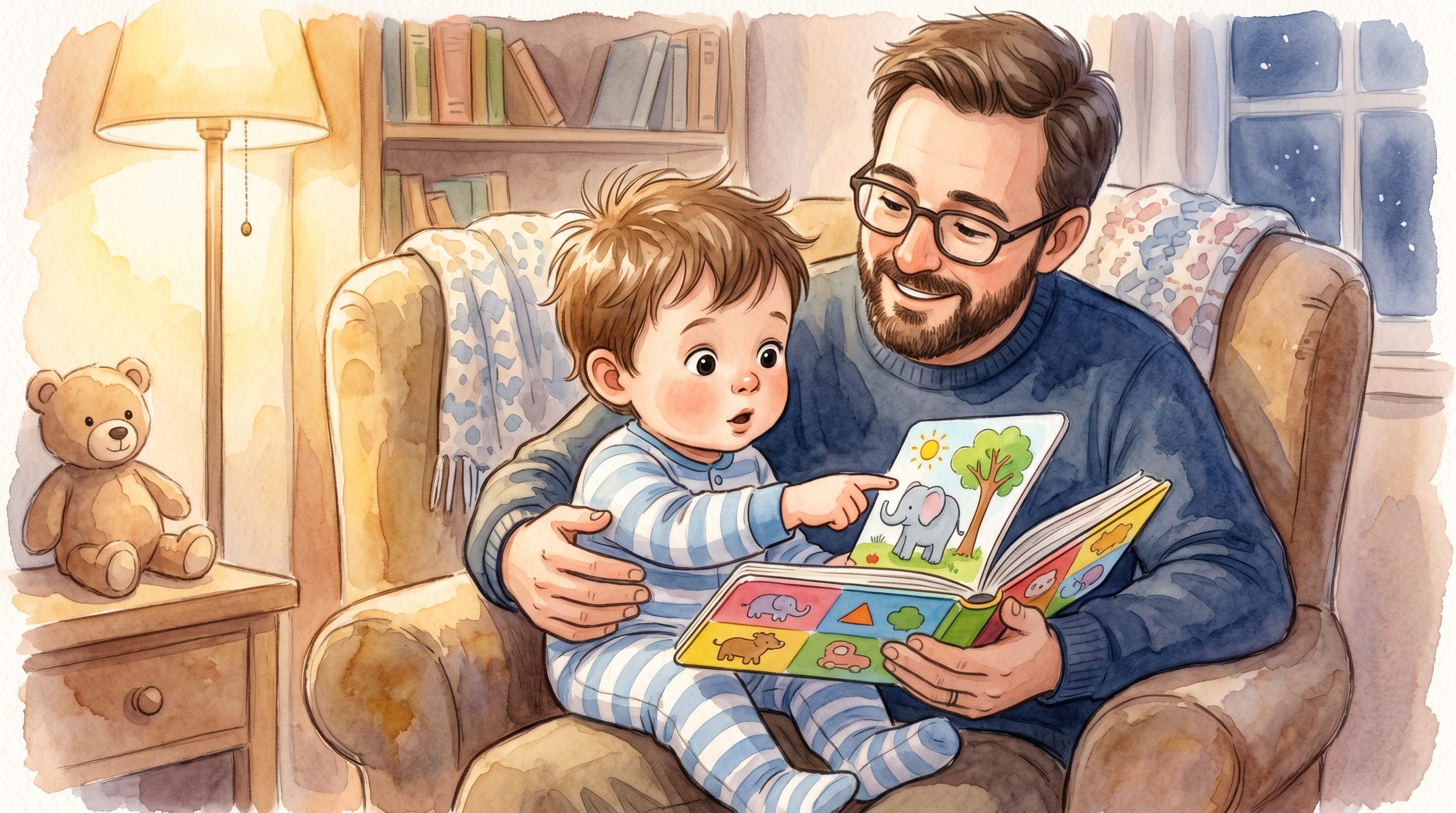
Step 1: Show them the picture first. Before you read a single word, put the image in front of them and ask, "What do you see?" Let them talk. This creates buy-in before the content even starts.
Step 2: Read one sentence. One. Not a paragraph — a sentence. Something like "God made the sky and the trees and you." Say it slowly. Make eye contact.
Step 3: Ask a simple pointing question. "Can you point to the sky in this picture?" "Where's the tree?" "Where are you?" This physically anchors the idea.
Step 4: Say the truth together. Repeat the core idea in the simplest possible words — something they can echo back. "God made me." Do it twice. Let them say it with you.
Step 5: Pray in one sentence. "God, thank you for making us. Amen." Done. That's the whole thing.
This is not dumbing it down. This is exactly calibrated to how a 3-year-old processes the world. Short. Concrete. Participatory. Repeated. That's what sticks.
What to Look For in a Devotional for a 3-Year-Old
When you're evaluating options, run them through this checklist:
- Big, clear illustrations. Not busy. Not cluttered. One central image per page that a toddler can identify immediately.
- One core idea per session. Not three takeaways. One. If you can't say it in a single short sentence, it's too much for this age.
- Short text. Ideally 2-4 sentences per reading, max. If you're skimming half the page to keep their attention, the book isn't working for you.
- Natural stopping points. Good toddler devotionals give you a moment to pause and interact — a question, a prompt, a simple action — not just a wall of text.
- Age-appropriate theology. At 3, the core truths are: God made me. God loves me. I can talk to God. That's it. You don't need more than that at this age.
If you're looking for something that hits all of these marks, the Who Made Me series on Hosted Devotions was built specifically for this stage. It's short, it centers on identity and creation, and the format is designed for the point-and-talk approach — so you're not adapting a book meant for older kids. It's already calibrated for a 3-year-old's window.
For more on how to structure devotional time with toddlers, this guide for dads with young kids goes deeper on the practical setup.
Consistency Beats Length Every Time
Here's the thing dads don't always hear: two minutes every night beats twenty minutes once a week. Especially at 3. The repetition is the point. When your kid hears "God made me" at bedtime 30 nights in a row, it doesn't need to be a theological lecture to become something they believe. Routine is how toddlers build their understanding of the world — and that applies to spiritual truth just as much as it applies to brushing teeth.
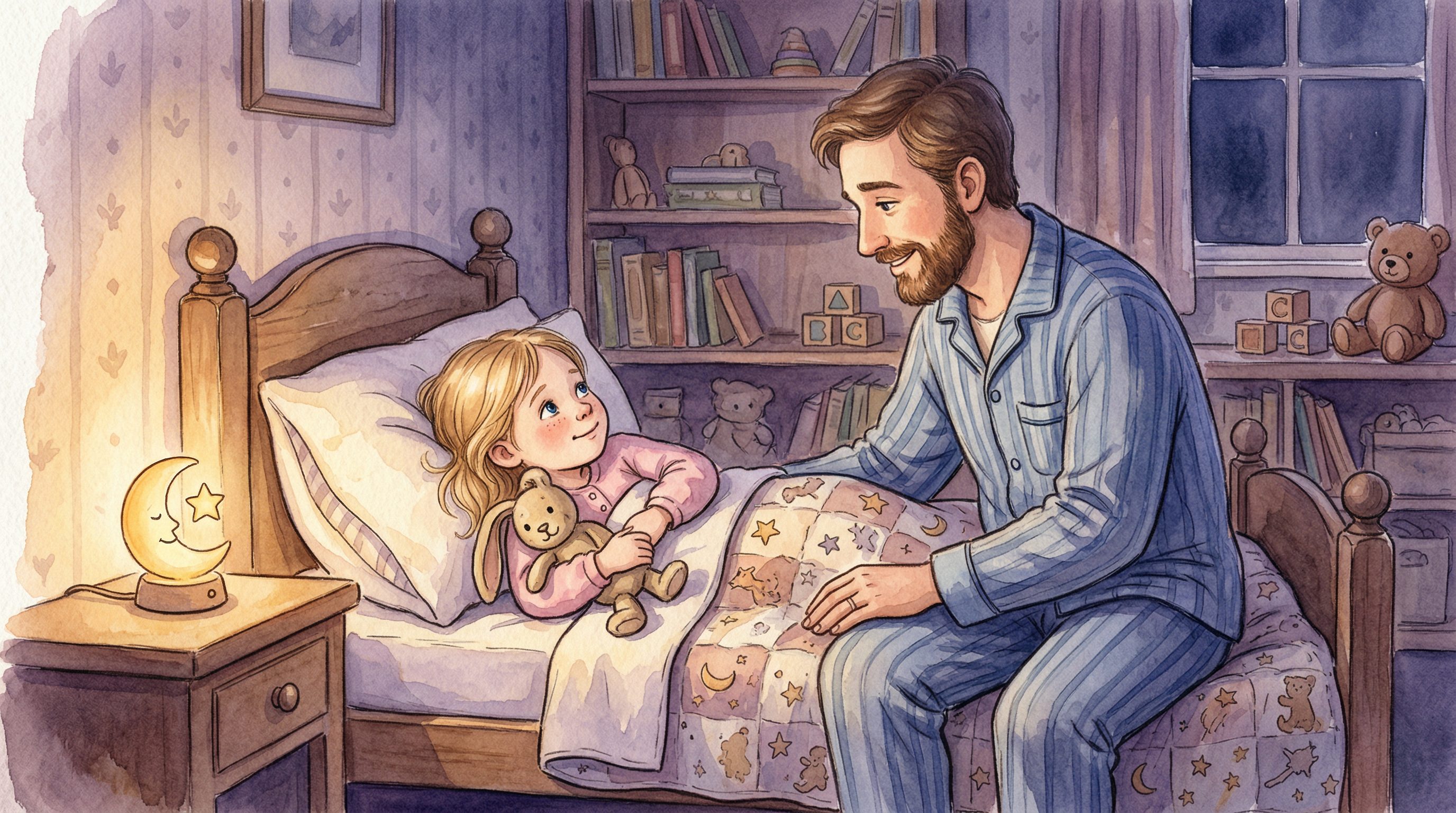
Don't measure success by how much you got through. Measure it by whether they wanted to do it again. At 3, if your kid reaches up for the book when you sit on the edge of the bed, you're winning.
If you're still figuring out when to do this, not just what to read — bedtime is almost always the right answer for this age. The kids are already still, already in your arms, already winding down. Here's how to build the bedtime routine if you're starting from scratch.

The Books Worth Knowing About
There are a handful of toddler devotionals that actually hold up at this age. The common thread in the ones that work: they're visually driven, they have very short text per page, and they repeat simple truths across multiple readings rather than trying to cover everything in one session.
What to avoid: anything with more than four or five sentences per reading, anything that requires your kid to sit and listen without participation, and anything where the illustrations are cluttered or abstract. At 3, if they can't immediately identify what's in the picture, you've already lost them.
The point-and-talk format works with almost any picture-heavy book — you don't need a perfect devotional to start. What you need is something short enough to finish, clear enough to discuss, and repeatable enough to do again tomorrow. If you have a children's Bible with illustrations your kid loves, that already qualifies. Start there and build the habit. The content can get more sophisticated as they grow.
One More Thing About This Age
When my younger son was 3, the moment that stuck with me wasn't a long devotional. It was him pointing at a picture of the stars and saying, completely unprompted, "God made those." That was it. That was the whole payoff.
It didn't come from a 15-minute session. It came from doing something short and simple, night after night, until it became part of how he sees things. That's the goal at 3. Small truth. Repeated often. Spoken in the dark at bedtime by a dad who showed up.
Also check out what works for the next age up — the best devotional approach for 4-year-olds is a natural next step as your kid grows into more curiosity and conversation.
📖 Read This Tonight
The Who Made Me series is built for the point-and-talk format — short, picture-centered readings that answer the biggest question a 3-year-old has: where did I come from? Start it tonight.
Get Notified When New Series Drop
We add new devotional series regularly. Sign up to hear about them first.
Join the Community